This is a very lightly edited version of the prepared text for my recent presentation at the 2026 annual joint meeting of the Western Canadian Philosophical Association (WCPA) and the Canadian Society for Environmental Philosophy (CSEP/SCPE).
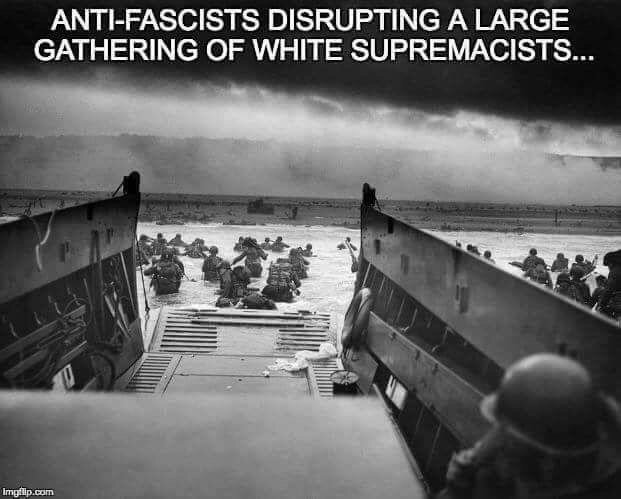
Today I am going to discuss civic nationalism. From a militant left perspective, discussions of nationalism tend to focus on either “the national question”—meaning the political status of movements led by oppressed national minorities—or the ruthless critique of far-right “supremacist nationalism.” What we will explore here under the moniker of “civic nationalism” could be categorized as a form of liberal antifascism. I myself have done this. This kind of antifascist civic nationalism is epitomized by the meme that captions Robert F. Sargent’s famous photograph of Allied troops landing in Normandy, Into the Jaws of Death, with text such as “Anti-fascists disrupting a large gathering of white supremacists…” Yet there is a potent mix of symbolism and an allure of unity in civic nationalism that we miss if we do not recognize it as nationalism.
However, nationalism is more commonly discussed and criticized from a liberal angle. From this perspective, nationalism is viewed as a recrudescence of some type of chauvinism or supremacism grounded on the idea that a homogenous ethnicity, language, culture, and/or religion legitimates a nation-state; hence nationalism is a social structure that civil society has progressively surpassed or is in the process of surpassing. Yet, this liberal perspective has long had difficulty with disentangling supremacist nationalisms and the national consciousness of the oppressed—here I would point to liberal responses to the Black Power movements of the 1960s and 1970s.
And yet liberalism embraces a kind of civic nationalism. Canadians regularly evince nationalist sentiments that rest on the differences between Canada and the U.S. In the most recent federal election, now Prime Minister Mark Carney tapped into these sentiments to defeat his conservative opponent, while Donald Trump mused about tariffs and annexing Canada. However, civic nationalism is hardly exclusive to Canada. As Americans approach mid-term elections, one can detect the sentiment that civic nationalism is an antidote to Trump and the far right and a guiding light whenever the post-Trump era emerges.
Antifascism must confront the conditions that make far-right movements possible. We cannot accept the institutions and practices of the settler polity as neutral or progressive norms.
Now, nationalism, even civic nationalism, can be an amorphous object of analysis. Therefore, it is useful to examine how a philosopher or political thinker outlines a specific case for nationalism. Here, we will look at the work of Jason Stanley, who has published two books on fascism: How Fascism Works: The Politics of Us and Them (2018) and Erasing History: How Fascists Rewrite the Past to Control the Future (2024). In 2025, he accepted an appointment at Munk School of Global Affairs at University of Toronto and relocated to Canada, and in January 2026, he published two editorials in the Toronto Star: “I left Trump’s America to teach in Canada last year. I didn’t expect this from Canadians” (January 9, 2026); then, with co-author Ron Deibert, “What Carney failed to say in Davos is what the world needed to hear most from Canada” (January 23, 2026).
These two editorials highlight the importance of civic nationalism in Stanley’s work. The problem of nationalism plays a small role in How Fascism Works, perhaps, but what he calls “anti-colonial nationalism” plays a prominent part in Erasing History. Stanley characterizes these two books as the first two parts of a trilogy; he envisions a third that handles how to “stop” fascism. Here, I will argue that what he characterizes as “anti-colonial nationalism”—as opposed to “supremacist nationalism”—is instead a form of civic nationalism that aims to maintain or salvage the settler-colonial polity. I use “polity here to designate the interplay of civil society and the state to produce a given set of aspirational norms and ideals within a specific settler-colonial jurisdiction. Therefore, when I use the term “polity” I also mean that norms and ideals it evokes preclude meaningful decolonization and Indigenous resurgence.
Two consequences follow: first, the settler-colonial state will attempt to capture resurgence through the paradigm of what Glen Sean Coulthard calls the colonial politics of recognition, or discourses and institutional practices of “recognition and accommodation” which may include some degree of cultural recognition, “land claim settlements, economic development initiatives, and self-government agreements” that ultimately maintain the colonial relationship between colonizer and colonized by reinforcing settler-state power (Red Skin, White Masks, 6; 3).
Thus, second, civic nationalism reinforces one of the key pillars that conditions far-right discourses and movements in settler-colonial states—legal, social, and political settler privilege. When we reflect on the problem from an angle that acknowledges ongoing structures of settler colonialism, the apparent binary between civic nationalism and supremacist nationalism looks a lot more like a spectrum within settler-state hegemony. Militants cannot allow antifascist struggle to be defined by a binary opposition between civic nationalism and supremacist nationalism, which obstructs a revolutionary alternative. I will argue that Stanley’s civic nationalism ultimately aims to salvage the liberal-settler project, and that his critique of settler colonialism remains insufficient. In this regard, this essay expands on my previous criticisms of his work.
Let us begin with his recent book, Erasing History. There, he defines supremacist nationalism as a “self-aggrandizing conception of the nation” that justifies domination through appeals to racial superiority or to a shared religion or tradition. He also distinguishes between “universalist” and “non-universalist” forms of supremacism. The former justifies domination by representing itself as the “standard-bearer of civilization” contrasted to the savagery of the Other; with the latter, he claims, the colonizing nation justifies itself “simply because of its military power” (Erasing History, 47). His example of “non-universalist” supremacism, curiously, overlooks the development of the European New Right, a current of the far right that has had a strong influence on contemporary supremacists in the U.S. and Canada. As Matthew N. Lyons summarizes:
European New Rightists championed ‘bicultural diversity’ against the homogenization supposedly brought by liberalism and globalization. They argued that true anti-racism requires separating racial and ethnic groups to protect their unique cultures, and that true feminism defends natural gender differences, instead of supposedly forcing women to ‘divest themselves of their femininity.’ ENR writers also rejected the principle of universal human rights as ‘a strategic weapon of Western ethnocentrism’ that stifles cultural diversity. (Insurgent Supremacists, 58)
This tendency is often misunderstood or misrecognized since it mimics the language of diversity. We could say it proposes its own version of “DEI”: ‘diversity,’ exclusion, and inequality. Either version of supremacism can lay the foundation for fascism.
Yet Stanley does not reject nationalism tout court. He contrasts supremacist nationalism with what he calls “anti-colonial nationalism.” Drawing on J.A. Hobson—of all theorists—he characterizes anticolonial nationalism as compatible with a “cooperative, peaceful ethos of internationalism” (Erasing History, 65–66). He also distinguishes between its universalist and non-universalist forms. The former embraces a kind of “Enlightenment liberalism” that recognizes that each cultural tradition share “a common universal humanity that places obligations of equal respect and dignity for other cultures,” while the latter rejects Enlightenment ideals because “those ideals were used, usually cynically, to support” colonialism (Erasing History, 47). While this categorization equivocates between liberal principles and universality, at least Stanley’s account does not allow liberal theorists to peremptorily dismiss supposedly non-universalist anticolonial nationalisms as reactionary.
Beyond this point, however, problems emerge. Erasing History is largely focused on education and its role in the formation of citizens within a liberal democratic polity. Most of his examples and prescriptions are drawn from this context, which reveals how anticolonial nationalism is a misnomer for what is more appropriately characterized as civic nationalism. For example, when Stanley writes that the program of an anticolonial nationalism would “acknowledge [a] country’s past sins, yet would also recognize that it still retains great promise,” this sounds more like a settler-colonial polity attempting to reckon with its past, not one of the pressing tasks of a colonized people fighting oppression (Erasing History, 68).
I think this problem is most obvious when Stanley describes how an anticolonial nationalism would look in the U.S. This passage calls on Americans and repeatedly refers to America, meaning that it ultimately assumes an already constituted socio-political identity and polity, both which have been challenged within the political struggles of national minorities and the colonized. He writes that anticolonial nationalism
would be a view according to which Americans are bound by an important common interest (for example, in democracy) and engaged in the shared project of elevating living standards for all. One could be proud to be an American because of its natural beauty, its cultural productions, its wondrous cities, and its diverse population without believing that America is the greatest nation in human history. This kind of American nationalism would be anti-colonial, committed to a distinctly American project of nurturing its vast diversity rather than suppressing it, while also addressing structural problems of inequality. (Erasing History, 68)
This program is hardly new; I recognize this as a long-standing practice of liberal education in the U.S., albeit one that is now under threat from the far right. Although fascism is a kind of supremacist nationalism, it does not follow that civic nationalism becomes anticolonial nationalism. I do not see, in his work, a true anticolonial political project that would by necessity—since these struggles are about land and autonomy—call the norms and institutions of the settler-colonial polity into question, while challenging the ongoing rather than past instances of dispossession and exploitation; instead, I see a kind of “anticolonialism” without an anticolonial subject, an attempt by the liberal side of settler colonialism to salvage the American polity from the excesses of the current far-right moment. There may be a civic nationalist consciousness of settler colonialism, but not an anticolonial national consciousness. Let us now turn to Stanley’s two editorials, where he slides between advocating for and uncritically espousing civic nationalism.
These two editorials should be evaluated in light of the civic nationalism that he outlines in Erasing History: a critically oriented civic pride that rests on a commitment, first, to democratic values and inclusion, and, second, to rectifying structural inequalities. In “I left Trump’s America,” Stanley outlines the program of a “robust” Canadian nationalism. While it fulfills the terms of the first plank of his civic nationalism, the endorsement—in line with a kind of liberal political realism—of investment in the military and infrastructure development necessarily encroaches on the rights of Indigenous communities, who often bear the brunt of the environmental impacts of resource extraction (infrastructure development, less euphemistically) and an additional loss of their land base. Therefore, Stanley’s position re-entrenches, rather than rectifying, structural inequalities.
Where Stanley and Deibert see a contrast between a good Canadian civic nationalism and a bad American supremacist nationalism, I see two divergent paths to manage capitalist strategy framed in terms of a popular, nationalist form.
In “What Carney Failed to Say,” Stanley and Deibert advocate for, but then, I will argue, lapse into espousing a Canadian civic nationalism that would not meet the standard set out in Erasing History; that is, it fails to maintain a critical attitude toward the Canadian state. Instead, they get caught up in contrasting the Canadian polity with the American polity. Indeed, this editorial has what is perhaps Stanley’s strongest negative judgments about the U.S. In any case, they offer a contrast between how U.S. institutions are moving increasingly to obstruct the possibility of reckoning with the past, while Canada has moved in the opposite direction. They write: “the U.S. has been making it ever more difficult to teach students about Indigenous genocide, chattel slavery and Jim Crow; meanwhile Canada is using education to reckon with its settler-colonialist past.” Stanley shows, in Erasing History, how the right and the far right have attempted to undermine American educational systems; by contrast, the efforts of the Canadian state at so-called Reconciliation may appear to offer a pointed contrast. However, this effort is largely managed by settler institutions, and it does not contest the underlying power relationships constitutive of ongoing settler colonialism in Canada. But we should also note that Stanley and Deibert characterize settler colonialism as a thing of the past. Education alone is not sufficient to undermine these structural inequalities.
Despite acknowledging settler colonialism as a structure of oppression which requires a reckoning, they then claim that
As the forces of nativism and xenophobia threaten democracies the world over, it is more essential now than ever that our prime minister stand up for the values that our tolerant, multiracial society embodies. Canada is a healthy, pluralistic and multicultural democracy that boasts a strong social-welfare system and has always respected human rights and the rule of law. [My emphasis]
Here, Stanley and Deibert lapse into espousing a non-critical form of civic nationalism. It is obviously false, on their own acknowledgement, that Canada has always respected human rights. They hardly scratch the surface concerning the injustices of settler colonialism. However, what is at stake is not only the past. By situating civic nationalism and supremacist nationalism as a binary opposition, and by characterizing the former, unjustifiably, as anticolonial nationalism, this approach ends up occluding actual anticolonial forms of national consciousness.
Since [Stanley and Deibert’s approach] does not address structural inequalities and affirms the legitimacy of the settler polity, it actually increases the leverage of far-right movements.
In the full version of this paper, I discuss what I would call Leanne Betasamosake Simpson’s Nishnaabeg national consciousness. Since I think I have time to choose one aspect of it, I will focus on her account of gender and gender liberation. Fascist and far-right movements embrace both ethnonationalism and masculinist chauvinism, though the latter can be harder to discern given the prevalence of hetero-patriarchy and -normativity in the settler-colonial polity. Looking at Simpson’s work points to a way that true decolonization uproots one of the conditions for the rise of the far-right and fascism.
She notes that the standard critical discussion of the Indian Act—for instance, imposed status and membership regulations, the pass system to restrict movement, restrictions on legal representation, the ban on Sundance and Potlatch ceremonies, and the imposition of band council administration—fails to capture how “the performance of settler governmentality in Canada…is strategically gendered” (As We Have Always Done, 118). She shows that the Canadian colonial system imposed hetero-patriarchy and -normativity on two-spirit and queer Indigenous peoples while relegating women—where they held a high degree of political and economic autonomy—to subordinate positions in their communities.
Nishnaabeg relations point to an organization of responsibilities—which the western tradition would see only as a division of labor—that is not structured to alienate the producer from the products of their labor and to subordinate the producer to the process of production, but structured to decentralize social and political power and increase social autonomy. Nishnaabeg women had a high degree of personal, bodily, and political autonomy within their community. And this autonomy was tied to responsibilities, which enabled the decentralization of economic and political power. Simpson writes:
Nishnaabeg women skilled and adept in the practices of hunting, trapping, fishing, sugaring, ricing, gardening, and harvesting medicines were economically independent from the settler economy and therefore were less reliant on their husbands and Indian agents economically. This afforded them a higher level of freedom and autonomy that in turn posed a greater threat to assimilation. Thus, dismantling the power and influence of Indigenous women became important to the destruction of Indigenous nations. (As We Have Always Done, 111)
According to this anticolonial national consciousness worthy of the name, decolonization entails liberation from the settler system of hetero-patriarchy and -normativity. True decolonization uproots one of the system of norms that the far right presents as natural, inevitable, and desirable—and which is none of the above. From my perspective, Simpson offers a far more rigorous challenge to supremacist nationalism than mere civic nationalism.
Where Stanley and Deibert see a contrast between a good Canadian civic nationalism and a bad American supremacist nationalism, I see two divergent paths to manage capitalist strategy framed in terms of a popular, nationalist form. That Stanley and Deibert are willing to exaggerate their moral defence of the Canadian polity demonstrates that they are willing to make a kind of wager on behalf of civic nationalism, which requires salvaging the settler polity while deferring the redress of structural inequality until an indeterminate future date in order to stave off the far right. But since it does not address structural inequalities and affirms the legitimacy of the settler polity, it actually increases the leverage of far-right movements. Within a settler colonial project, the settler polity holds a dominant position over the colonized and, therefore, the colonizer’s culture—which contributes to the norms of the Canadian polity—is more likely to transform the perception of victimhood or perceived threats to the privileged status of settlers into chauvinism or political opportunism than into an egalitarian project. Stanley and Deibert contribute to this dynamic when they exaggerate the human rights record of the Canadian settler polity.
Simpson’s political vision stands in stark contrast with Stanley’s “realism,” whereby “investing in the military and building new infrastructure are essential.” A robust nationalism invested economically and ideologically in “new infrastructure” and the military will at some point collide with Indigenous nations, stoking another recrudescence of settler chauvinism and supremacy, which certainly won’t stave off the far right within Canada’s borders. Antifascism must confront the conditions that make far-right movements possible. We cannot accept the institutions and practices of the settler polity as neutral or progressive norms; we cannot reduce our public to its settler public. We cannot just fight against settler colonialism and capitalism; we must fight alongside, with the currents of national consciousness that run through the stolen lands in which we live.
Books Cited
Coulthard, Glen Sean. Red Skin, White Masks: Rejecting the Colonial Politics of Recognition (Minneapolis: University of Minnesota Press, 2014).
Lyons, Matthew N. Insurgent Supremacists: The U.S. Far Right’s Challenge to State and Empire (Montreal: Kersplebedeb, 2018).
Simpson, Leanne Betasamosake. As We Have Always Done: Indigenous Freedom Through Radical Resistance (Minneapolis: University of Minnesota Press, 2017).
Stanley, Jason. Erasing History: How Fascists Rewrite the Past to Control the Future (New York: One Signal Publishers/Atria, 2026).