Balancing war and peace has long been integral to Donald Trump’s popular image. Making America Great Again has always included making America militarily dominant and feared again, a longing that accords well with Trump’s fixation on winning, glorification of violence, and celebration of toxic masculinity. Yet Donald Trump’s absurd pretension to be the “peace president” isn’t just about narcissism and Obama envy, and it isn’t a sudden shift. In 2016, candidate Trump denounced “endless wars” and promised to bring US troops home from Afghanistan and the Middle East. This promise was part of his attack on the political establishment of both major parties, and he renewed it repeatedly in years following. As Brandan P. Buck of the Cato Institute wrote a year ago in an article about MAGA and Ukraine,
“[T]housands of future American populists fought, bled, and grew disillusioned [in the Iraq war]. Many of them were the latest to serve in a generational caste of American soldiers that is disproportionately rural, Southern, and conservative. These geographic and ideological contours mapped neatly onto Trump’s political base. The anguish of the wars in Iraq and Afghanistan, the lies that led to and sustained them, and a service gap between the ranks and the political leadership class soured the populist right on the foreign policy orthodoxies that sent them to war. This dissent served as an essential plank of the then-emerging populist perspective on modern American politics. In his 2016 electoral win, Trump benefited significantly from the issue of war and peace, specifically in the Midwest, and did so again in 2024.”
MAGA speaks to anti-war sentiment in the way that right-wing populism so often speaks: by rejecting a liberatory impulse in favor of a caricature that challenges the established order but bolsters oppression, violence, and human suffering. In this case, more specifically, MAGA’s “America First” outlook has challenged the structured order of imperialism established after World War II, which long provided a useful framework for U.S. military aggression. But in its place MAGA’s leader has promoted not principled internationalism or disarmament but rather unilateralist attacks and naked demands to seize territory and resources. And even MAGA critics of Trump’s military actions, such as Tucker Carlson, combine progressive-sounding antiwar sentiments with conspiracist scapegoating and a racist, anti-egalitarian vision of American nationhood.
“MAGA speaks to anti-war sentiment in the way that right-wing populism so often speaks: by rejecting a liberatory impulse in favor of a caricature that challenges the established order but bolsters oppression, violence, and human suffering.”
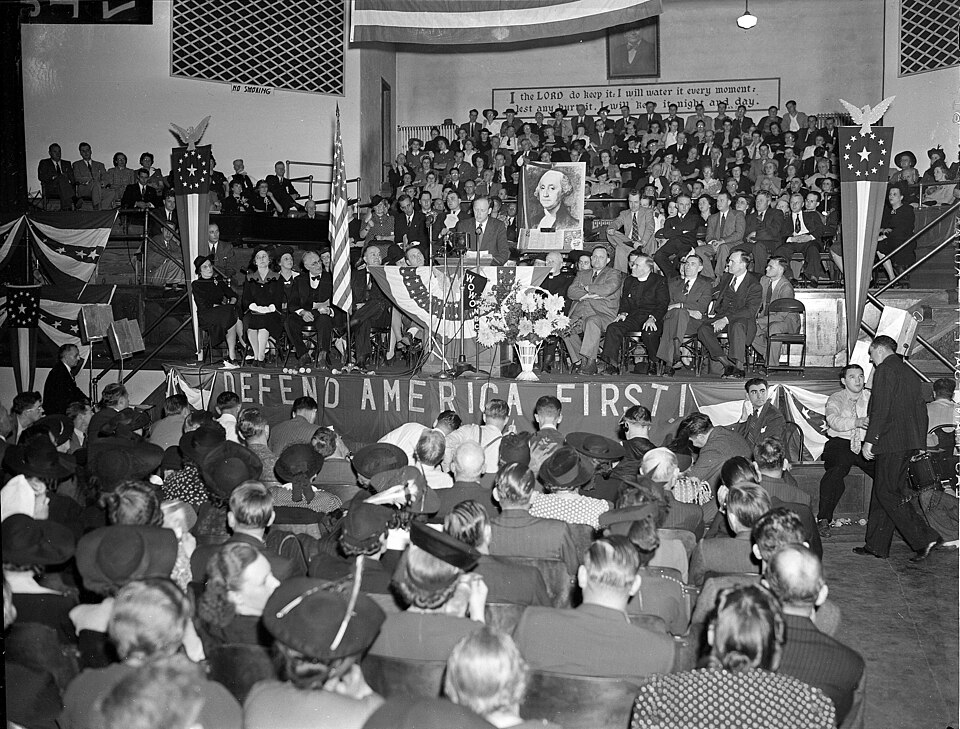
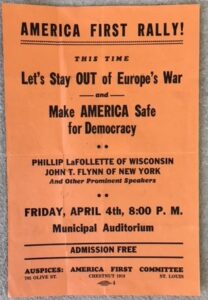
A number of factors have contributed to this shift, from the crisis of neoliberalism to Trump’s transactional approach to everything, but it’s helpful to look at the shift in the context of America First’s own history. Before Trump, the slogan was most prominently identified with the America First Committee of 1940-1941, one of the leading organizations that opposed U.S. entry into World War II. Like MAGA, the AFC was an autonomous mass movement misportrayed by some liberal critics as puppets of a foreign power (in this case Nazi Germany rather than Putin’s Russia)—a mass movement that wasn’t entirely fascist, but in which fascists gained credibility and influence by joining forces with nonfascist collaborators. The AFC appealed to a range of people against joining the world war, but its leadership centered on Midwestern businessmen who opposed the New Deal and the Eastern Establishment that had spawned Franklin Roosevelt, and who wanted the U.S. to focus on domestic markets rather than ally with the globalist, free-trading British Empire.
The America First Committee and the larger anti-interventionist movement collapsed after the Japanese attack on Pearl Harbor, but the slogan was revived half a century later. In the 1990s, after the Soviet Union dissolved and the Cold War ended, paleoconservatives such as Patrick Buchanan argued that the United States should rethink its international alliances such as NATO, withdraw overseas military forces, and use economic protectionism to rebuild struggling industries. In 1992, Buchanan challenged incumbent president George H. W. Bush for the Republican nomination and won about a quarter of the vote. Buchanan criticized Bush as a member of the Eastern elite and declared “He is a globalist and we are nationalists. He believes in some Pax Universalis; we believe in the Old Republic. He would put America’s wealth and power at the service of some vague New World Order; we will put America first.” Rewrite that at a 4th-grade level with repetition and more insults, and it starts to sound like Trump.
“In Schurmann’s sketch of [the 1940s America First] current we find many familiar themes, including conspiracist anti-elitism, hostility to international institutions and outlook, an emphasis on military power to ensure unilateral expansion of American free enterprise, and even an affinity with evangelical Christianity.”
A particularly helpful sketch of World War Two-era America Firstism can be found in The Logic of World Power by sociologist and historian Franz Schurmann, published in 1974. In a chapter tracing the major political currents that affected US foreign policy in the 1930s and 40s, Schurmann argues that the “isolationists” (as they’ve often been called) were in fact only isolationist with regard to Europe and were “the true heirs of ‘manifest destiny’ [who] looked westward to East Asia and southward to Latin America.” In Schurmann’s sketch of this current we find many familiar themes, including conspiracist anti-elitism, hostility to international institutions and outlook, an emphasis on military power to ensure unilateral expansion of American free enterprise, and even an affinity with evangelical Christianity. Here is an extended excerpt (from pages 56-60):
“The isolationist current was opposed to universalism. On the surface, it seemed to imply doctrines that the United States should not get involved in the war of other nations unless directly attacked…. In fact, isolationism was a form of American nationalism clearly expressed in its favorite slogan: America first.
“…The isolationists, except for their transient left-wing fringe, believed in American military power. Their congressional representatives voted eagerly for defense build-ups and displayed a typically nationalist admiration for the flag propped up by guns. They believed fervently that America should defend its interests by military force where threatened. Since those interests were obvious in Asia and Latin America, they were more prepared to challenge Japanese expansionism than that of Germany in Europe, and Mexico’s nationalization of United States-owned oil companies aroused an angry furor….
“The isolationists were anti-imperialist, which, in the 1930s and 1940s, meant being against the only world imperialism of the time, the British Empire. They regarded it as a global conspiracy on the part of vast financial interests centered in London abetted by similar interests in New York to dominate the world economy. The ultimate aim of Britain, they believed, was to create a world economic and political monopoly which would stifle the natural expansionist desire of late-comer powers, such as America. The isolationists were indeed expansionists, the true heirs of ‘manifest destiny.’ They saw a glorious future for America beyond its borders, but not particularly in Europe or Africa or Western Asia. They looked westward to East Asia and southward to Latin America. They believed in laissez-faire capitalism and were hostile to big government, whose only result could be to suppress freedom, the natural right of every individual to deploy his enterprise in the pursuit of his own interests. They believed in the individual, particularly the individual who decided to rise above the masses by acquiring wealth. They had a classical commitment to freedom, to a society subject only to minimal governance. Above all, they saw themselves as Americans, a definite, distinct, and proud nationality with a mission in the world. American, in the understanding of the day, meant white, Protestant, and male.
* * *
“…The expansionists saw the crash of the stock market and the subsequent breakdown of the international monetary system as conspiracies aimed at destroying them. When unions began to organize with the active support of the patrician Roosevelt, the expansionists saw an even greater conspiracy between the mighty of the Eastern Establishment and the communist-inspired labor unions to crush them in the middle. They saw themselves as the real driving force in America, the people who created enterprise and made the wealth which others, bankers and organized labor, then usurped. Expansionism and nationalism were identical in the minds of those who took the isolationist stance prior to 1941; the history of America in the Pacific had forged that identity.
America First Committee flyer, 1941
“If the nationalists saw expansionism and nationalism as identical, they pretended to see a similar identity between internationalism, communism, and imperialism. The big bankers of Wall Street were internationalist—so were the communists with their Marxist doctrines, and so were the British with their empire. Moreover, the growing alliance between the Roosevelt-led administration and the unions seemed to indicate a real alliance between the forces of international capital and their ostensible enemies, the revolutionary proletarians. All this could only be aimed at capitalism, as the nationalists saw it. The expansionist image of capitalism was that of the National Association of Manufacturers, which saw the corporation, producing and marketing things, and not the banks as the core of free enterprise capitalism. Socialism to them meant monopoly domination of the economy whether by immense finance capital, big government, or communist revolutionaries. When Hitler began to preach that an international conspiracy of capitalists, Jews, and Bolsheviks was trying to crush the expansionist drive of the German nation, many in the United States understood and sympathized. By the late 1930s, the Roosevelt-labor union alliance had expanded to include an emerging British-American alliance to oppose Germany. And after June 22, 1941, the archenemy of mankind, Bolshevik Russia, had joined….
“American nationalism remained isolationist until December 7, 1941. When Japan attacked America, militant nationalism immediately joined the fray. Japan was a welcome enemy for the nationalists. It was a non-white power threatening American interests in the Pacific. It was already at war with America’s special responsibility in the Far East, China. It was not at war with Bolshevik Russia, thus precluding Russian-American collaboration in the Far East, and, above all, the Japanese had the effrontery to attack their most admired symbol of American military power, the Navy. Hitler’s declaration of war against America completed the picture of an attack on two fronts, and war against both German and Japan was accepted by all American nationalists.
“…The war in the Pacific was run along nationalist lines on the American side…. The nationalism of the war against Japan was evident, for example, in the racism that accompanied it. While there was deep ideological revulsion against the Germans, there was little anti-German feeling in a racial sense, as in World War I. But the Japanese were hated as an upstart race. Japanese, but not Germans and Italians, were interned in concentration camps in the United States. Japanese captives in the Pacific were much more cruelly treated than German captives.
“Whereas the core belief of the internationalist current was the need for international systems, particularly economic, that of the nationalist current was the need for pre-eminent American military power. In a dangerous world, this was the only guarantee of American safety, for the defense of America’s interests, and, in particular, for the assurance of the ever-continuing outward expansion of American enterprise. America must have a powerful navy and develop new technologies, such as air power, to the hilt. It must have a powerful army, although the nationalists were always suspicious of universal military service. Above all, the nationalists advocated permanent American military bases throughout the world, particularly in the Pacific…. The American military presence would assure an ‘open door’ policy for American business to invest and do as it pleased in those countries. It would also assure the safety of American nationals there, notably missionaries, engaged in their own form of activity….”
White House Deputy Chief of Staff Stephen Miller addresses America First Policy Summit, December 4, 2025.
I first became aware of Schurmann’s work through that of historian Bruce Cumings. In Volume 2 of his The Origins of the Korean War, Cumings carries forward Schurmann’s sketch of isolationism/expansionism to look at its Cold War successor, the right-wing current that advocated “rollback” of communism (as opposed to containment). Cumings doesn’t use the label “America first,” but it’s the same: here again we see an approach to US imperialism that is oriented toward Asia (and Latin America) rather than Europe and that is “territorial instead of nonterritorial, resting on expansion by agglomeration and direct controls rather than indirect, economic levers; exclusive grasp of raw materials and markets (because of inability to compete in world markets)…” Here again we see advocacy of “[s]trong military departments but weak regulation of the economy; a heroic executive, a gutted State Department; strong FBI and covert action capability” and that “hatred of taxes and communists leads to fascination with cheap, high-tech weaponry for obliterating the enemy…; allies dominated and if recalcitrant, abandoned for fortress America” (page 30).
Cumings also argued that 1950s rollbackers shared with 1930s/40s isolationists
“a general lack of real interest in or connectedness with the rest of the world. Rollbackers are thus true ‘red-blooded’ Americans, the provincial residue of America’s ‘late’ enmeshment in the world. This lack of real connectedness explains the habitual propensity of rollbackers toward a self-protective withdrawal in the face of a recalcitrant world, or in the view of the hegemonic containment-liberal dominance of foreign policy after 1952. The utter unrealism of rollback policies…expresses the typical lack of interest in or knowledge of the world at large for these quintessential American nationalists” (page 31).
Such historical precedents don’t fully define MAGA or Trumpism, which are also shaped by major political, cultural, and economic changes of the past half century. But these sketches by Schurmann and Cumings indicate some of the deep ideological wells that today’s America First approach to foreign policy draws on.
Photo Credits
1. Charles Lindbergh addresses an America First Committee rally, Ft. Wayne, Indiana, 5 October 1941. Photo is free for public use, courtesy of CharlesLindbergh.com, via Wikimedia Commons.
2. America First Committee, March-April 1941. Public domain, via Wikimedia Commons.
3. U.S. Department of Homeland Security photo by Tia Dufour. Public domain, via Wikimedia Commons.