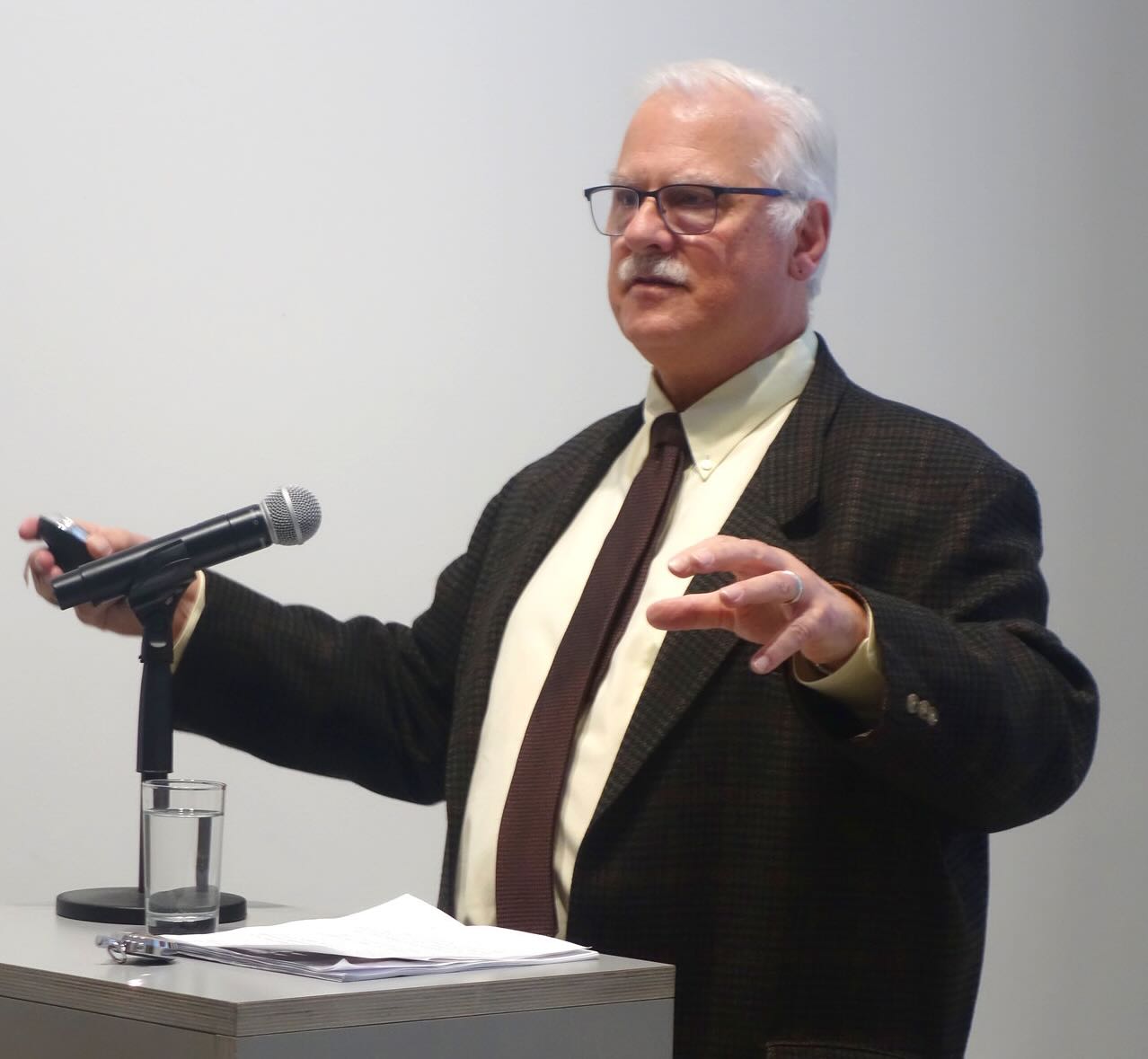
Three Way Fight mourns antifascist researcher, writer, and organizer Chip Berlet, who died on January 30th. For some fifty years, Chip was a dedicated opponent of both far right politics and state repression. As a paralegal with the National Lawyers Guild in the 1970s, he helped force the U.S. government to release 300,000 pages of documents about the FBI’s COINTELPRO (Counterintelligence Program) against leftists. In 1987, Chip Berlet and Jean Hardisty cofounded Political Research Associates, which quickly became one of the best sources of information and analysis on the U.S. right, thanks in large part to the 23 years that Chip spent there as senior research analyst.
Chip Berlet helped lay the foundations for much of today’s antifascist work, including Three Way Fight. We remember Chip for his commitment to liberatory principles, his groundbreaking exposés and insights on far right politics, and the comradely spirit with which he supported the work of other activists and researchers.
An obituary to Chip Berlet by Spencer Sunshine and Daryle Lamont Jenkins can be found on the antifascist website Idavox here.
Below is Matthew N. Lyons’s essay from the book Exposing the Right and Fighting for Democracy: Celebrating Chip Berlet as Journalist and Scholar, edited by Pam Chamberlain, Matthew N. Lyons, Abby Scher, and Spencer Sunshine (Routledge, 2021). The essay has been lightly adapted for online publication.
Chip Berlet, Co-author
By Matthew N. Lyons
Chip Berlet and I spent eight years working together on what became the book Right-Wing Populism in America (Guilford Press, 2000). That project had a big effect on my life and, I believe, Chip’s as well.
I first became aware of Chip’s work in the late 1980s, after Political Research Associates and Radical America published his exposé of the New Alliance Party and its affiliated groups. The party presented itself as a multi-racial, women of color-led, pro-gay organization supporting progressive popular movements, and it made a splash in 1988 when its presidential candidate, Lenora Fulani, got on the ballot in all fifty states. But behind the facade, the New Alliance Party was an authoritarian political cult run by former Lyndon LaRouche associate Fred Newman, whose operations were based on deception, opportunism, financial shell games, and using psychotherapy to coerce members. Chip was one of the first people to write about this, and as someone who had initially been taken in by the Newmanites’ phony radicalism, I appreciated his careful reporting and principled analysis.
Chip’s work touched my life even more closely in 1990, during the lead-up to the first U.S.-Iraq war, when he was one of very few journalists to warn against systematic efforts by the LaRouche network to infiltrate the antiwar movement. I had experienced this personally some weeks earlier, when one of the founders of the small-town antiwar group that I gravitated to admitted being a LaRouche supporter. The group voted to expel her (the LaRouchites’ history of spying on and physically attacking leftists overrode people’s desire to be open and inclusive), but it was a revelation to us to learn—from Chip’s reports that circulated on activist listservs, in those days of the pre-Web internet—that this wasn’t an isolated incident, but part of a coordinated, nationwide effort. It seemed bizarre that a fascist organization would try to join leftist-led coalitions against U.S. military expansionism and accuse then-President George H.W. Bush of genocide, and trying to make sense of this was one of the main things that drew me into studying and writing about far right politics myself.
In 1992, Chip published a report that put the LaRouchites’ antiwar activism in larger context. Right Woos Left: Populist Party, LaRouchian and Other Neo-fascist Overtures To Progressives, and Why They Must Be Rejected examined efforts by a variety of U.S. far rightists to build alliances with leftists against the U.S. government. Even more disturbing, the report showed that many leftists were willing, even eager, to embrace right-wing conspiracy theories, many of which were rooted in antisemitism, because they offered simple, radical-sounding critiques of the state and elite. As I learned later, Chip took a lot of heat for Right Woos Left, and several left-leaning magazines refused to run an article by him on the subject. The Progressive decided to run the article because their editor was tired of subscribers urging him to republish articles from The Spotlight, organ of the fascist Liberty Lobby. (A 1999 updated version of Right Woos Left is available on the PRA website.)
Right Woos Left inspired me to try to put the problem of right-wing, anti-elite conspiracism in historical context, in a draft article that I titled “Tracing the Roots of Conspiracy Thinking.” Its analysis was an eclectic mix, which tied anti-elite conspiracy theories to everything from antisemitism as a distorted form of anti-capitalism, to factional conflicts within the U.S. business community, to the recurrence of movements throughout U.S. history that have combined anti-elitism with a drive to expand and deepen white supremacy. Being new to publishing and not knowing quite what to do with the piece, I sent it to Chip with a letter introducing myself and thanking him for his work.
Chip’s reply to my letter said a lot about his intellectual generosity, and it proved to be a turning point for both of us. He offered to help me get the article published, but suggested that I might need to reduce the article’s focus on his own work in order to do so. He graciously accepted my one criticism of Right Woos Left—for endorsing Richard Hofstadter’s description of conspiracism as a “paranoid” feature of the political fringes, which I argued was overly psychological and obscured its roots in mainstream political assumptions. And although we had never met, he invited me to join forces with him to turn our analyses into a book. “If you have nothing better to do with the next six months,” is how he put it. That timetable proved to be a tad over-optimistic.
Writing any book is hard, and writing one with another person presents its own set of challenges. Chip and I have different backgrounds, different ways of working, different writing styles, and to a significant extent different politics. He was a dozen years older than me, worked full time at PRA as a researcher and analyst, was interviewed on NPR and published in the New York Times. I worked a series of day jobs, and my political outlets tended to be local rallies and teach-ins, photocopied pamphlets and newsletters. The situation could easily have lent itself to a mentor-mentee relationship, but Chip never even hinted that his greater experience should give him pride of place. He treated our collaboration as a partnership of equals—except he insisted I should get all of the publisher’s advance on the grounds that he was already getting paid for this work.
Chip recognized from the beginning that our differences could be a source of strength. His background as a journalist and my historical orientation complemented each other, and we ended up dividing the book evenly between us: I was lead author on the more historical first half, he on the second half covering developments of the past few decades. Only the introduction and conclusion were fully co-written. At the same time, each of us reviewed, commented on, and added to the other person’s chapters, and each of us made crucial contributions to the book’s analytic framework. For example, Chip brought in the concept of populism mid-way through the project based on the work of political theorist Margaret Canovan, while I borrowed the concept of producerism from the historian Alexander Saxton. The result of this back and forth was a work with a consistent, unified analysis that both of us felt fully comfortable with as representing our views.
Getting to that point wasn’t always smooth. The project had its ups and downs, difficulties and frustrations, but I don’t remember any actual arguments between us. Both of us made a point to be respectful and kind toward the other, but Chip showed more patience, as I tended to be harder on him than he was on me. A low point came after our original publisher dropped us for taking too long to deliver a manuscript, and it was Chip who went out and secured a new book deal with Guilford Press. He also used his contacts with sociologists and others in academia to help get our book onto course syllabi and into students’ book bags.
Throughout this time, Chip and I lived in different parts of the country, and our collaboration was carried out mostly via email, phone, and mail. But I started coming to the Boston area regularly and visited Chip many times at PRA’s old offices in Cambridge—first in Central Square, then on Beacon Street, just a couple of blocks from the house where I first lived as an infant. Having access to the PRA research library, which Chip had worked hard to build up over years, was tremendously helpful. And listening to Chip’s old stories was a treat, whether they were about protesting with the Zippies (an early 1970s breakaway from the Yippies), helping to uncover the FBI’s dirty tricks in COINTELPRO with the National Lawyers Guild, or confronting neo-Nazis in Chicago.
Since Right-Wing Populism in America was published, Chip and I have been in touch irregularly, as each of us has moved on to other projects. To a large extent our work has continued to run along related tracks but has not often converged. But despite how irregularly we are in contact now, and despite the fact that we sometimes disagree, the connection we formed through writing a book together over eight years feels permanent, like an extended family connection. And the graciousness, generosity, and respect that Chip consistently brought to our collaboration remains a model I try to emulate.
Note
Right-Wing Populism in America won the Outstanding Book Award, Gustavus Myers Center for the Study of Bigotry and Human Rights in North America, and is still in print.
Photo Credit
Rosa Luxemburg Stiftung—New York Office, 6 March 2018, CC BY-NC-SA 2.0, via Flickr. The image has been cropped.