Editor’s note (by Matthew N. Lyons):
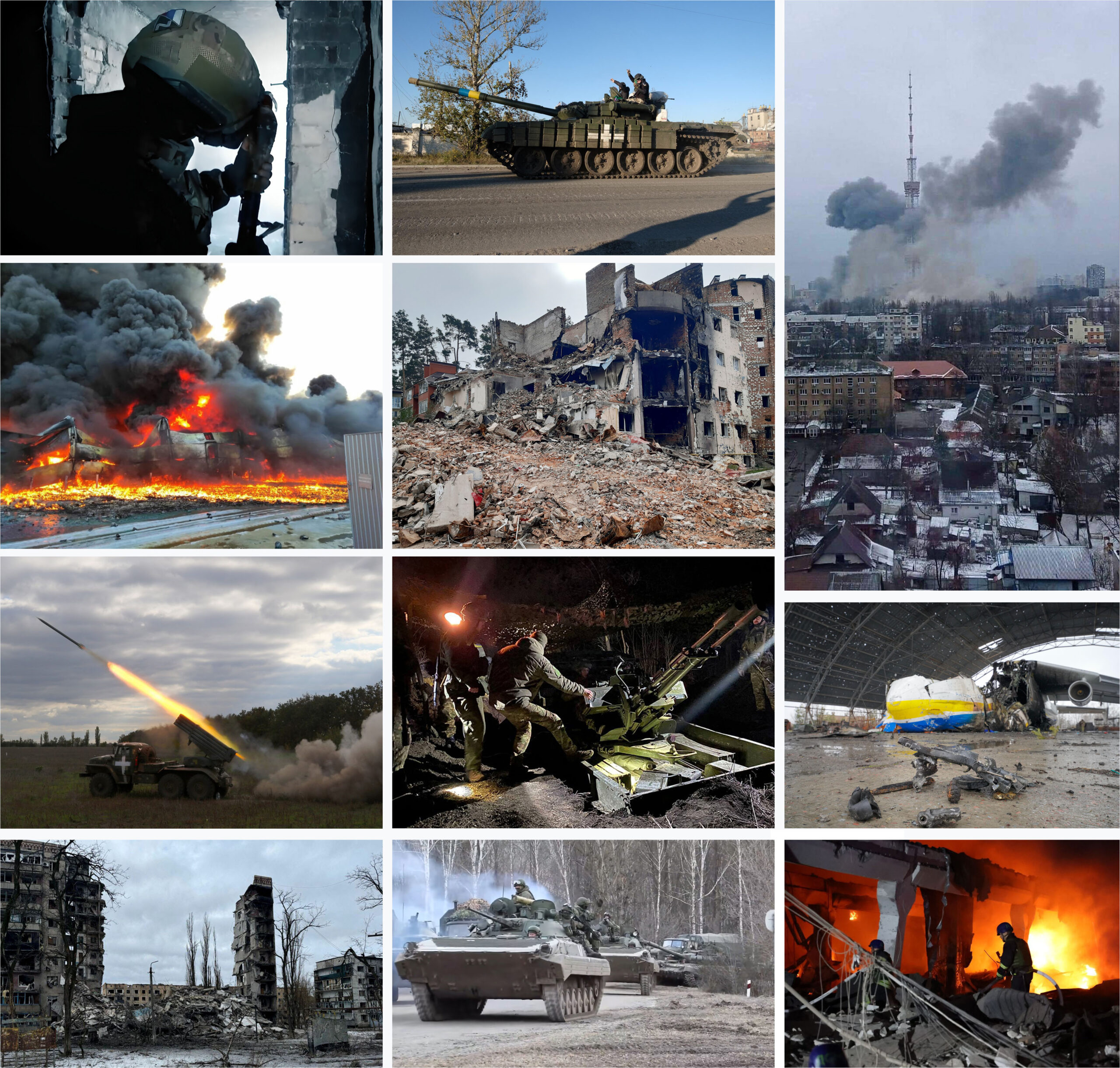
Russia’s full-scale invasion of Ukraine is well into its fourth year. This war has killed hundreds of thousands of soldiers and tens of thousands of Ukrainian civilians, and has forced millions of Ukrainians to flee their homes, including some eight million who have been internally displaced and six million who have become refugees in other countries. Russian air attacks have largely targeted civilians and civilian infrastructure, and the Russian military has carried out widespread and systematic human rights violations in Ukraine, ranging from torture to forcible Russification of schools and media to the mass abduction of children.
To facilitate and justify the Russian invasion, Vladimir Putin’s reactionary, authoritarian regime and its supporters have carried out a systematic disinformation campaign, falsely claiming that there is no historical basis for Ukrainian nationhood, that the invasion is simply a defensive response to NATO aggression, and that Ukraine is ruled and mostly populated by Nazis. Some western leftists and liberals have bought into these lies, based on a “campist” view that any seeming opponent of U.S. or western imperialism should be supported.
The opposite pitfall is to frame the war as a defense of western democracy against authoritarianism, obscuring western powers’ readiness to embrace dictatorship and genocide when they serve the interests of global capitalism, or glossing over repressive tendencies by Ukraine’s capitalist state.
A three way fight approach challenges us to avoid both of these pitfalls, in the same way that it challenges us to oppose the U.S./Israeli war on Iran while also supporting popular resistance to Iran’s brutal theocratic regime.
Yet proponents of the Three Way Fight project have not had a unified position on the Russia-Ukraine war. While some (myself included) have advocated support for Ukrainian resistance against Russian imperialism, others have rejected such support as endorsement of a capitalist state, and one that has aligned itself with western imperialist powers.
In June 2022 I highlighted the writings of British leftist Simon Pirani as a helpful effort to address the complexities of the Russia-Ukraine war from an informed liberatory perspective, for example, his description of Russia as being in a subordinate position relative to the big western states but an imperialist power relative to many of its neighbors. Since then, Pirani has continued to urge western leftists to support Ukrainian resistance while also criticizing NATO and western imperialism (and linking support for Ukraine with opposition to Israeli genocide in Gaza). He has also noted the sharp disparity between the murderous political repression within Putin’s Russia and the relative space within Ukraine for people to demonstrate and criticize the government, while also warning against “creeping authoritarianism in wartime Ukraine (the concentration of power, constraints on parliament and on labour organisations).”
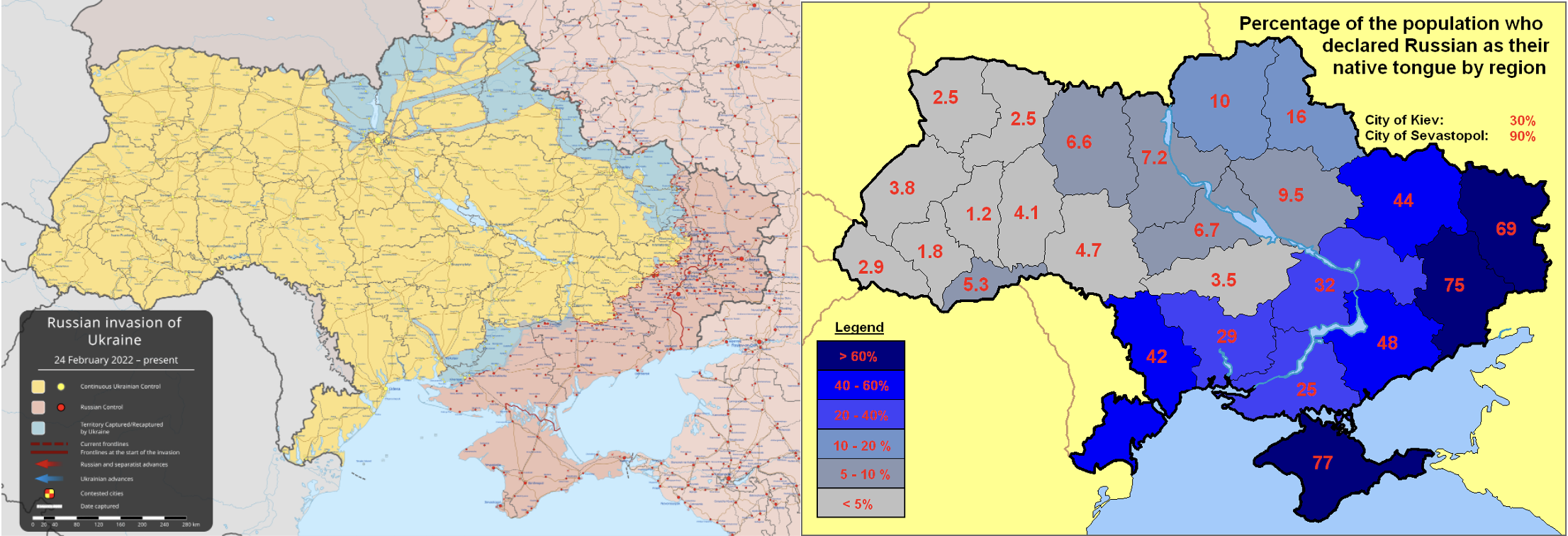
The essay below centers on another aspect of this complexity: language repression within Ukraine. Russian-speaking Ukrainians, who mostly live in the southern and eastern parts of the country, form the bulk of the civilians who have been massacred and forcibly displaced by Putin’s armies. Yet the Russian government cynically claims that it is fighting, in large part, to protect Russian speakers, and has suppressed Ukrainian language instruction in schools within the territories it occupies.
Meanwhile many Ukrainians have reacted by treating Russian language and cultural identity as marks of disloyalty. Although the Ukrainian constitution prohibits linguistic discrimination, court decisions and laws passed by Ukraine’s parliament have stripped Russian speakers of legal protections as a cultural minority. As Oleksandr Kyselov has written, millions of Russian speakers who have fled to unoccupied parts of Ukraine are accused of “bringing the occupier’s language” with them, and prominent figures call for physical violence against even children who use Russian. This is part of the context in which Ilya Kharkow wrote the following essay.
The Day I Threw Away a Book
by Ilya Kharkow
It was one of those days that gives you heartburn whenever you remember it. The year was 2022. The beginning of the war between Russia and Ukraine. An old bus was carrying me toward the border with the EU. All I wanted was to escape, because I was not ready to kill others on someone’s orders.
In a way, I had already escaped. My journey had begun in Kyiv, and now I was approaching Uzhhorod, a provincial Ukrainian city located near Hungary and Slovakia.
Already on the way to Uzhhorod I was surrounded by people speaking a different language. I didn’t understand their jokes. I didn’t understand their slang. Their accent was different. This was still Ukraine, but it was nothing like my home places: Kyiv, Dnipro, or Zaporizhzhia. Here there was a different culture, a different anger, different peculiarities. Not better or worse, just different. My ignorance of these peculiarities gave me away as a stranger. In the first days of the war, being a stranger in a country that had been attacked was very, very dangerous.
An introvert, but not a hermit. A rational minimalist. A practical dreamer. A man of discipline. An existential observer. A skeptic. I could go on describing myself in colorful detail, but I have other methods. Not words, but actions—that’s what describes a person best. I say this as a writer.
The action with which I am about to write my portrait sounds like this: “At one of the stops on the way to Uzhhorod, I threw a book into a trash bin.” Before doing it, I opened the book at a random page. It said: “The world is the art of living alongside other people’s mistakes.”
I closed the book. My hand went into the trash bin.
A rough version of the inner dialogue at that moment:
“Are you seriously doing this?”
“Yes.”
“But you’re a writer.”
“Exactly.”
Yes, I still call myself a writer. Yes, a book is the most valuable thing I own. And yes, I threw a book into a trash bin. Near a roadside diner. I threw it in, and then reached in and covered it with garbage. What an asshole, right?
“Being a stranger in a country that had been attacked was very, very dangerous.”
That day, I committed several crimes:
- ran from the war
- spoke the wrong language
- threw away a book
- and still considered myself a writer.
All my life I lived in the Russian-speaking part of Ukraine. No one in my hometown (a mining town) spoke Ukrainian. I was raised on Russian culture. I used to travel to Western Ukraine as if it were abroad. Everything there was different, interesting, unlike what surrounded me at home. But with the beginning of the full-scale war, everything Russian suddenly became forbidden. Russian-speaking guys, fleeing en masse toward the western border, looked suspicious. Locals met us with undisguised aggression. And since I spoke Ukrainian like a stuttering foreigner, silence became my last refuge.
I threw away the book. Damn, how carefully I prepared for my escape. Part of my backpack was taken up by food (canned peas and Snickers), part by a minimal set of clothes (a sweater, pants, and a pair of underwear), and all the rest—books.
Ask me why Roman culture fascinates the modern world despite its massive reliance on slavery. Unfortunately, I can’t answer that, though I’d like to. The History of the Roman Empire—that was the book I threw away at the stop. The thing is, it was in Russian. Why is the Roman Republic considered a political model if most of the population had no political rights? I’d like to know that too. Why in Rome was it not the partner’s gender that mattered, but their social role? It’s interesting, isn’t it… I threw away the book. Yes. And you know what? It was the most honest thing I did that day. But I kept another one—a concentration camp guard’s diary. I didn’t throw it away only because it was in English. English, too, could be blamed: British policy was expansionist for a long time, and many geopolitical actions of the United States could easily start a fight in any bar. But is it right to blame a language for the sins of those who use it?
“Is it right to blame a language for the sins of those who use it?”
On the bus, not far from me, two men were arguing. First in Russian. Then one of them suddenly switched to Ukrainian. As if he had changed weapons. At some point, a strange thought crossed my mind: if books could choose their owners, this one would have chosen someone braver.
And yet, the guard’s diary stayed with me. When I was afraid, I read its pages, which became even more horrifying from the fact that they were written not in ink, but in indifference—in the literal absence of a soul.
I bought both of these books before the war began, with one goal—to understand politics a little better, to estimate the chances that war might actually start. Of course, these weren’t the only two books I bought. Max Stirner. Friedrich Nietzsche. A Brief History of England. The history of Nicholas II’s reign…
Well, I have to admit, I was late. I simply didn’t have time to adjust. All my life I thought on the scale of a human being, and only just before the war did local news offer me a new lens—thinking on the scale of a country, or even the entire world.
But what do different countries talk about? States like to ban things. States want to protect teenagers from social media. The church—from insults. The population—from songs about drugs.
For example, Turkey protects the country from Wikipedia. And in Singapore, they protect asphalt from chewing gum. Everyone is protecting something. But somehow, it only gets scarier. Tell me, do you feel care in these bans?
In Japan, they protect slimness. They measure office workers’ waists. In North Korea, they protect people from foreign films. In some countries, they even protect history.
Or maybe they’re right, and I should be afraid of the Russian language? Why do we need music that mentions drugs? Do you really want your husband to become an addict? Why do we need popular social networks? Teenagers are pushed to suicide there or drawn into the porn industry. Do you really want that for your kid? Really, why do we need a slim waist in the office and a stupid Wikipedia on vacation?
All of this sounds logical only as long as these news items are seamlessly woven into the context of propaganda. But the moment you step away from the news, even briefly, the skeletons fall out of the closet on their own. And a simple question arises—are we really so afraid of each other that we are ready to believe we need protection through restrictions?
The argument on the bus was getting louder and more furious. The same two men were still fighting over politics. One said the war was necessary. The other said it was inevitable. Neither of them was going to the front.
What a relief that four years have passed since that trip to the western border. Stress. Fear. Uncertainty. Loss of friends. Changing cities. Countries. A shift from a settled life to a nomadic one. The status of a permanent emigrant. I got used to all of that. But I threw a book into a trash bin, and I still mentally return to that bus and that bin. These thoughts bring me bitterness and, at the same time, gratitude. But it’s a strange kind of gratitude. The kind you might feel for a blow that left a scar… and the scar turned out to be beautiful.
Four years have passed, and I find myself thinking more and more that only a society that does not need protection from words can be free. Negative experience is an inevitable part of growing up. A child constantly shielded from mistakes can easily be made obedient, but never strong. The same happens to society. The more the state protects people from ideas, books, and words, the less capable they are of distinguishing truth from propaganda on their own.
If I could go back in time and meet myself at the moment when I was throwing that book into the trash, I would come up and say: “Freedom begins where society stops being treated like a child.” It would sound absurd. Out of place. But I would want that so much.
Would I allow myself to throw a book into the trash just because it is written in Russian while I am in a Ukrainian-speaking part of the country? Yes, I would. Simply because at that moment and in that place, carrying a Russian-language book in my backpack was dangerous. Should I accept this? No, I should not, and I will not.
I threw away the book not because the language made it bad. I threw it away because in a world where people kill each other over language, sometimes you have to choose between principles and safety.
Ilya Kharkow is a writer from Ukraine.
If you want to find more:
Kharkow’s website: ikharkow.com
Blog: Notes on Refusal: ikharkow.substack.com
Support Author: buymeacoffee.com/ikharkow
Image credits:
1. 2022 Russian invasion of Ukraine photo montage. Montage created by Hoben7599. CC BY-SA 3.0. Via Wikimedia Commons.
2. At left: map of the Russian invasion of Ukraine, as of April 2026. By Rr016 and Yakiv Gluck. CC BY-SA 4.0. Via Wikimedia Commons. At right: map of Russian speakers in Ukraine based on the 2001 Ukrainian census. CC BY-SA 2.5. Via Wikimedia Commons.