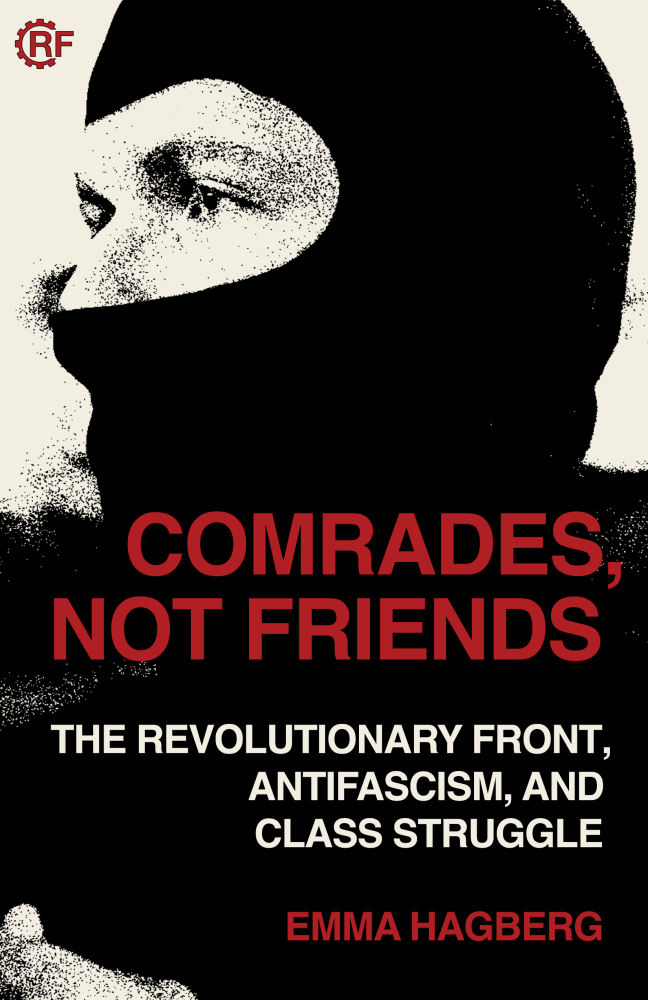
Emma Hagberg, Comrades, Not Friends: The Revolutionary Front, Antifascism, and Class Struggle
Oakland: PM Press, 2026
224 pages; paperback $19.95; ISBN 9798887440194
Review by Dandy Andy
When, in a heavily mediatized event, the alt-right leader Richard Spencer was punched in the head by an antifascist activist at the celebration of Donald Trump’s first inauguration on January 20, 2017, it led to numerous memes, slogans, chants, and no shortage of graffiti about punching Nazis, but it didn’t lead to much punching of Nazis, outside of the occasional skirmish at counterdemonstrations.
PM Press recently released Comrades, Not Friends, the English translation of Emma Hagberg’s 2024 book about the working-class Swedish antifascist group the Revolutionary Front (RF), a group that existed from 2000 until 2015 and did, in fact, explicitly come into being to beat the shit out of Nazis. It is a fascinating story rife with drama, contradictions, and lessons, both positive and negative. It is not my intention here to tell the story of the Revolutionary Front. Anyone interested in that should read this snappy, high-paced history in which Hagberg chooses to let the protagonists tell their story in their own words with no editorializing. It will be well worth your time. I’m more interested in what lessons the book has to offer us in our current situation in the US and Canada.
Violence, Machismo, and Gender
The issue of violence is, not surprisingly, at the center of the book. It is an issue that is revisited numerous times from various points of view in a discussion that brings to the fore many of the complexities that are generally absent when the discussion is largely theoretical. It is an issue that the antifascist movement will inevitably have to address at some point, and RF’s experience offers us a useful starting point.
I can’t imagine an antifascist movement that is ideologically committed to non-violence, as that would fall somewhere between masochistic and suicidal when dealing with highly motivated thugs committed to the utter marginalization, if not annihilation, of their chosen Other(s) and any opposition that should arise. That, however, is not a blanket endorsement of violence in every situation—violence can be a tactic, but it can never be a strategy. As a former RF member says (everyone quoted in the book is anonymous, for obvious reasons): “For us, violence was never a moral question. If we had to beat someone up, that’s what we had to do. It was never about morality. Violence is just a tool” (14). RF also avoided the error of elevating violence above other forms of resistance, or at least attempted to: “I don’t get off on violence as such, but I never had moral qualms about kicking a Nazi in the head. You have to leave that part of the job to those who are capable of doing it. It’s not for everybody” (16).
“I can’t imagine an antifascist movement that is ideologically committed to non-violence, as that would fall somewhere between masochistic and suicidal when dealing with highly motivated thugs committed to the utter marginalization, if not annihilation, of their chosen Other(s) and any opposition that should arise.”
At the same time, at least some former members of the group recognized the ease with which violence sometimes became a category apart from other movement practices: “we always knew that you don’t battle fascism on the streets only. There has always been a romanticization of street fighting, even among those who can’t handle it” (17). Even if the pitfalls of romanticization are avoided, there is still the risk of violence becoming mundane. As a former member noted, “Violence becomes normalized, and reservations about using it gradually disappear” (37). The consequences of that are perhaps best expressed by another former member who acknowledges that some RF members “could get violent outside of politics when they had too much to drink” (76), and, I would imagine, in some cases when they had not had too much to drink.
Addressing tactical concerns separate from the ideological issues surrounding the use of violence, Thomas Rothaus says in his “Foreword”: “It is questionable whether a revolutionary militant should really risk life and liberty to confront any random fascist they encounter, no matter the place, the time, or the odds” (xii). That, however, was precisely the mission that the RF set for itself. As one former member summarized the group’s ethos: “the RF doctrine: ‘Never hesitate! Never retreat! Always punch first! Be with comrades you trust a hundred percent! No one is left behind!’” (83). This meant in practice, as one former member explains, “even when we’re outnumbered. Six against ten? No problem, we’ll attack nonetheless!” (6–7). Essential to this approach, of course, is the idea underlying “no one left behind.” As one former member formulates it: “Loyalty is always crucial when you engage in violent action, anywhere in the world. That’s well documented” (19).
As an ultimate defense of the use of violence, a former RF member argues that “Nazis on the streets aren’t just an eyesore, they are a threat to many people. You can only get rid of that threat through violence” (48).
It is precisely the “threat” Nazis and other toxic far-right elements pose “to many people” that makes any argument that violence is always unacceptable in the antifascist struggle untenable. That would amount to deserting the people targeted by far-right violence and retreating to the safety of our privilege, whether it be one of class, race, gender, or culture. That is not to argue that the movement should essentialize violence as the responsibility of everyone who sees themself as an antifascist. As a former member quoted above notes, violence is “not for everybody” (16), and as another former member points out, people not genuinely prepared for a street clash “just get in the way” (6). It is to argue that the antifascist movement must recognize that comrades who engage in more confrontational tactics, up to and including the use of violence, are a legitimate part of our movement and deserve our unreserved solidarity. The lack of widespread support for the comrades swept up in the Prairieland arrests, as well as the limited support following the arrests of pro-Palestinian activists, indicates that we as a movement have not begun to grapple with these questions in a meaningful way.
This does not mean that there can never be differences, disagreements, and criticisms, but in the spirit of “loyalty” discussed above, those differences, disagreements, and criticisms need to be addressed “in house” in a way that does not aid our enemy by providing insight into our movement or exposing differences that can be instrumentalized against us, that does not break solidarity, and that does not make us appear fractious and divided.
This also doesn’t mean that we need to adopt the RF principle of attacking every noxious far-right activist we cross paths with as a matter of principle. As Thomas Rothaus points out, it is questionable that insistently attacking every random Nazi regardless of the potential consequences actually makes sense (xii). Reflecting on this issue ex post facto, one former member says, “In hindsight, maybe we should have been more restrained at times. The repression might not have gotten so hard. In that sense, the violence was perhaps counterproductive” (49). In a context closer to home, Anti-Racist Action, arguably the key antifascist group active in the US and Canada from the late 1980s until the early 2000s, had as its slogan “we go where they go.” Nonetheless, a former member told me of instances when the group would find itself so seriously outnumbered and outmaneuvered that to avoid serious injury, possibly even death, with no foreseeable net gain, it made sense to beat a tactical retreat.
This is to suggest that while strict moral objection to the use of violence must be rejected, the use of violence must, nonetheless, be subjected to a nuanced tactical assessment, and there may be times when it is wiser to retreat than to engage in action that can only lead to grave consequences for the participants. To let pride or ego muddy the waters of a sound analysis is a serious defeat in its own right, as would be insistently adhering to a tactic in a situation where failure is likely.
“The use of violence must…be subjected to a nuanced tactical assessment, and there may be times when it is wiser to retreat than to engage in action that can only lead to grave consequences for the participants. To let pride or ego muddy the waters of a sound analysis is a serious defeat in its own right, as would be insistently adhering to a tactic in a situation where failure is likely.”
It is also important to understand that violence exists on a spectrum. There is a distinction between self-defense and initiating violence. While the vast majority of antifascists would agree that it is legitimate to resist violent aggression on the part of far-right opponents with counter-violence, there will undoubtedly be disagreements about the strategy adopted by RF of proactively hunting Nazis, although the argument can be made that preemptively attacking people who intend to attack their perceived opponents is a form of self-defense, and that is essentially the position that RF adopted. Armed violence was never an issue in the RF approach, but in the US where guns are ubiquitous, the argument in favour of self-defense could be extended to include armed self-defense against armed attack, an issue that events around the George Floyd uprising, for example, indicate is not just theoretical. It is clear that nothing in RF’s practice posed a danger to uninvolved people, which suggests an ethical guideline antifascists should embrace: any violence engaged in should be carried out in a way that ensures, as far as possible, that there is no collateral damage. A risk of collateral damage would arguably be a reason for not carrying out an action or even for retreating rather than attacking.
It is impossible to engage with the issue of violence as the RF practiced it without also addressing the issue of machismo in the antifascist movement, and it is an issue about which different former members hold different positions.
One former member says, “Yes, there was machismo, which is not surprising under these circumstances. We had no time for therapy sessions, we just followed very clear principles: either you kick that motherfucker in the face, or he will kick you. . . . For me, it is very simple: either you are ready to kick the shit out of that fucker or you aren’t. There isn’t much to talk about. When you are under attack, the only logical response is to strike back and not stop before the other one is down” (19–20). The problem with this particular formulation is that RF was not under attack from fascists but, rather, was actively seeking out fascists to attack, literally roaming the streets to do so.
Another former member held a similar position, but with an important nuance: “Well, the macho thing . . . if you consider what we did, then a macho element was inevitable. And it has an impact on the kind of people you attract. . . . At some point, it all becomes a self-fulfilling prophecy: You have a certain membership, and you’ll attract people who fit that membership. I think we could have changed some of the internal culture, but to get rid of the macho element completely? Considering what we did? Impossible. You can’t be good at street fighting and permanently question yourself, that doesn’t work. As a result, you’d be a worse street fighter. Look at the members who hung out with hooligans, or—maybe even worse—the ones who became criminals. They were the most brutal, and, truth be told, sometimes it sucked being around them. They were extremely macho, and at the same time very insecure boys. It should have not gone as far as it did in their cases, but again, to completely avoid that element would have been impossible” (74). Addressing the hooliganism element, a former member argues that “the macho stuff, the flirts with hooliganism, those things weren’t good, and we should have made a bigger effort to correct them. But it wasn’t easy amid all the violence” (42).
Approaching the question from a different angle, a former member argues: “There was some truth to [the macho criticism], but it was also a feature that attracted many to RF. And the macho thing might have been necessary. Without the hard rhetoric, we might have been less successful” (165). In a similar way another former member asserts, “RF was as macho as it had to be. I suppose violence in itself is macho: You want others to be scared of you, and you act tough. . . . [W]ith regard to appearing tough, yes, that was a macho ideal” (75–76). The upshot, however, as another former member notes, was that “our tough-guy image scared the Nazis, but it also scared others” (28).
Inevitably, the machismo that RF cultivated had gender implications. That an organization that numerous former members acknowledge was “macho” and that prioritized violence would prove alienating to women should come as no surprise. As one former member contextualizes the issue, “Many members had no political schooling, they were not socialized in the left. They appeared crude, and it might have been off-putting to women” (75). While this was doubtless true, another former member acknowledges that not enough was done to address the problem: “We should have made a bigger effort to bring women into the organization. The more time that passed, the more difficult it became to do something against the male dominance” (183). Although in later years, the organization made a certain effort to address the problem, as one former member acknowledges, the culture of the group was a factor that was never sufficiently addressed: “Some think that the organization did too little to attract women. Others think that gender had no relevance. During RF’s final years, the efforts to recruit women increased and women members were more visible in RF propaganda. Yet there were members who thought until the very end of RF that for a militant group active on the streets, diversity wasn’t particularly important. . . . [T]he macho culture within RF was linked to the street fights that characterized RF’s early years, as it might not have made RF particularly attractive to women. Other members concede that there was a macho culture in RF even apart from the street fighting, and that it should have been acknowledged as a problem and dealt with” (73). Another former member attempts to sidestep the issue, arguing, “During the final years, the membership of women increased. And, just to be clear, it’s not like you have all that many women in other leftist groups either, or in politics in general” (75).
No former member who addresses the issue says anything to suggest that the number of women was ever significant; the very way the issue is consistently skirted make it a reasonable supposition that this was not a case. The argument that “it’s not like you have all that many women in other leftist groups either” sidesteps the central issue. While it is true that sexism and male dominance is an issue across the left, that is distinct from a failure, perhaps even a refusal, to address the implication of an image and a practice that would certainly preclude any significant participation of women. The participation of LGBTQ+ people is never addressed, but it is reasonable to presume that the extreme masculinism of the group would have proven alienating to that demographic as well. This points to a serious contradiction for an organization that argues, “As revolutionary antifascists, our goal must not be simply opposition to fascism but working toward a liberated society, in which the conditions that breed fascism are a thing of the past” (xii).
It is becoming increasingly obvious that the antifascist movement in the US and Canada needs to address the question of violence. Over the past two years, since the second Trump victory, neo-Nazi and white supremacist groups have been actively working to normalize their presence in the streets and to introduce their noxious ideology into public debate. We see this in the US with the frequent public appearance of the Patriot Front and a plethora of smaller more localized groups in US cities in growing numbers and with increasing impunity, as well as in the brazen public organizing of Robert Rundo’s Active Clubs, which are rapidly becoming an international phenomenon. This is also true in Canada, where the Second Sons are using the same approach to develop a public presence. It is of no small concern that these groups have begun to meet and develop a strategy that extends across borders.
It is almost inevitable that this development will lead to violent clashes between neo-Nazi organizations and the antifascist movement. In that light, it behooves us to take seriously the experience of RF, both its positive and negative aspects, and determine how we can best prepare for coming conflicts in a way that allows us to replicate RF’s success at driving fascists off the streets, while finding an approach that does not reproduce the machismo and masculinism. In spite of what appears to be the tendency of former RF members to at least partially shrug off this problem, there is no reason to conclude the guys have to take care of the Nazis while women and LGBTQ+ comrades cheer from the sidelines. Among other things this would overlook the strength that women and LGBTQ+ people must develop to face the daily adversity they encounter, a reality most able-bodied cis men, cis white men in particular, will never experience. Respect for women, LGBTQ+, and disabled comrades requires us to address this issue seriously.
The Danger of Left Elitism
The comparison made above to “other leftist groups” brings us to a key issue—the way in which RF’s sense of alienation from and the critique it developed of the rest of the Swedish autonomist left shaped its ideology and aesthetics. The title of this book is meant to reflect how RF perceived the rest of the antifascist movement—as “comrades” but not as “friends.” One former member provides an example of the group’s relationship with the autonomist left: “They needed us for protection, and they asked for it. Then, we were there for eight hours and they left without saying goodbye” (17). This was seen as the result of the “insular, hyperintellectual, and largely student and middle-class character of autonomous antifascism” (xi). RF argued that the autonomist section of the antifascist left—represented primarily in the form of Antifascist Action, a group with whom RF maintained an uneasy alliance—engaged in “‘research and surveillance’ of Nazis. . .—‘research for research’s sake’—a way for middle-class activists unwilling to put themselves in danger to feel good about themselves?” (xii). This criticism points to a real problem; while most militant antifascists have probably had the experience RF describes here at one time or another, trivializing the importance of “research and surveillance,” and minimizing, if not outright ignoring, both the importance of this work and the risk it entails for the comrades who do it is to respond to sectarian behavior with more sectarian behavior.
As a movement we need to recognize, as some RF members quoted above do, that there is room for people to play different roles. If there is a dividing line, it is not between comrades engaged in different activities but between the radical section of the movement that sees the antifascist struggle as a component of a broader anti-capitalist struggle and liberal factions that see the end goal as defending and preserving a liberal or possibly social democratic form of bourgeois democracy. Even this dividing line must be negotiated with some subtlety. Radical antifascists are in a minority in the current political environment, so not only must we find a way to publicly preserve our anti-capitalist position, we must also find a way, as much in practice as in theory, to have our perspective be part of the larger discussion in a way that maintains overall solidarity. This is obviously a delicate balancing act, but it is an essential one. There is always room for comradely disagreement between various tendencies within the antifascist movement, or any other movement. Given that such disagreements are inevitable and in some cases likely irresolvable, it is essential that these debates be conducted in a politically mature way and not deteriorate into infighting that manifests as personal attacks, denunciations of groups embracing different tactics (the oft-lauded but frequently disregarded recognition of a diversity of tactics), identifying people in a way that leaves them open to state repression, or failing to express solidarity with comrades facing repression. This sort of behavior would not only weaken us; at this juncture, it would prove disastrous.
“There is always room for comradely disagreement between various tendencies within the antifascist movement, or any other movement. …it is essential that these debates be conducted in a politically mature way and not deteriorate into infighting that manifests as personal attacks, denunciations of groups embracing different tactics…, identifying people in a way that leaves them open to state repression, or failing to express solidarity with comrades facing repression.”
Expanding on the tension between RF and the rest of the autonomist left, a former RF member says, “for people who do not belong to the white middle class, who do not listen to a certain kind of music, who do not dress in a certain way, and who do not express themselves in a certain way, there is no place” (69), with another saying, “The RF founders found it difficult to bring childhood friends to [autonomous left] political events, since they were rejected because of their background, their conduct, or merely their clothes” (4). This leads a former member to ask, “Were we not alienating people with our intellectualism, our insular language, and our scenester ghetto behavior?” adding, “As revolutionary antifascists, our goal must not be simply opposition to fascism but working toward a liberated society, in which the conditions that breed fascism are a thing of the past. But how do we build a movement when we are wholly incapable of communicating with society at large?” (xii). This raises a valid issue: all too often the left alienates the very people whose interests it claims to represent. There is no question that if antifascist forces are to play a role in the larger public debate we must find a way to communicate with people outside of our milieu in a patient, nonjudgmental, and engaging way. Not every person who holds views we disagree with or even shares certain right-wing views is an enemy, and only by engaging people in a non-threatening way can we hope to make inroads and change minds.
To address this problem RF adopted an aesthetic that separated them from the rest of the far left. “We looked normal and didn’t want to look like the rest of the left,” adopting a style described as “‘whole[some] and clean.” Not only did this serve to distinguish RF from the rest of the antifascist movement, it also had “an advantage when faced by cops and, especially, fascists. Not only did we see the latter when they didn’t see us, but in the case of many an unfortunate nationalist, they mistook us for friendlies” (x). Of this decision, one former member says, “In the early days, we could walk right into an assembly of Nazis, no problem. We were skins and hooligans, we didn’t look like the leftists they knew” (24). As another former member explains, “The Nazis often thought we belonged to them. It was a classic to start an attack by approaching them with the question ‘Hey, are you nationalists too?’ Then we started swinging the second they emphatically said, ‘Yes!’” (42).
This also extended to a decision not to mask up. A founding member explains, “In many ways, it was an advantage not to wear masks. Without a mask, it was easy to just blend into the crowd once you’d left the scene of a crime. No one cared about a bunch of youths strolling about. Normality was our mask” (9). On a larger level, another former member says, “There was no reason to hide. We knew that we could only reach our goal if we were as transparent and approachable as possible. We had to make it easy for the people who wanted to support us” (110). However, the aforementioned founding member did acknowledge the different circumstances faced by current activists: “there weren’t as many surveillance cameras around as there are today” (9).
While the RF’s chosen aesthetic was clearly rooted in the sense of alienation from the broader far left, as well as serving a tactical purpose, it was, more importantly, rooted in the RF’s particular understanding of class politics and revolution, and this is where it is most important to engage with RF’s politics.
Bringing It Back to Class
While RF’s decision to prioritize Nazi hunting set it apart from other antifascists active in Sweden at the time, and was a source of both strengths and weaknesses, and while their aesthetic decision, which was both ideological and tactical, was also a marked difference from their contemporaries, both of those elements were an outgrowth of what was most unique and most important about RF, its class politics. As one former member puts it, “RF’s main issue was class, nothing else mattered to us,” noting at the same time a failure to develop a nuanced proletarian position, “Class incorporates gender rights and all those questions, but it’s true, we didn’t pay much attention to them” (63). As we have seen this was more than just a passing weakness, incubating, as it did, a significant masculinist distortion, with arguably necessary violence giving rise to a macho culture within the group.
In this context, the same former member argues that “antifascism was important because the Nazis posed a threat to working-class unity” (66). Expanding on this idea another former member tells us that “for RF, fascism was a symptom of class society. Even if they considered defeating the fascists on the streets necessary, they knew that this alone would not lead to a classless society” (101). This points to a significant fissure within the antifascist movement, that between liberal antifascists whose objective stops at protecting liberal bourgeois democracy from the fascist threat, while helplessly surrendering electoral democracy to the far right, and anti-capitalist antifascists, who see antifascism as a secondary, albeit essential, movement addressing the threat posed by the far right to create greater maneuvering room for revolutionary anti-capitalist forces.
It is easy, however, for anti-capitalist working-class politics to be superseded by antifascism, particularly in periods when the far right is on the rise. As one former RF member says, “There were ambitions to do more community and union work, but in the end, antifascism always came first. In hindsight, this wasn’t ideal perhaps. It would have been interesting to see how far we could have come had we given more attention to other things” (36), later adding, “I think it would have been very interesting to see what we could have achieved politically had the focus on antifascism not been so strong” (38). Another former member argues, “Organizing your workplace is the strongest weapon in the class struggle. Insecure employment creates insecure lives” (132). In this regard, another former member observes, “Antifascist work attracts people. Class politics less so, which makes the question of how to do it right a difficult one” (45). This is no less a conundrum for revolutionary antifascists active now than it was for RF, our weakness in this regard perhaps being even more pronounced. It is essential that not only the antifascist movement but the left more broadly find a way to reintegrate class politics into our movement and beyond that to again develop a proletarian perspective that sees all elements of liberation tied to achieving a classless society. The fact that the reader might find this statement rhetorical, or even feel that it sounds somewhat ridiculous, is an indication of our overall current weakness and our need to address that.
Perhaps the most poignant observation about the threat we face if we do not find a way to turn antifascist politics into revolutionary class politics that go beyond chasing far-right groupuscules off the street comes in the final paragraph in the book: “Former members have stressed repeatedly in this book that although they were able to chase the Nazis out of the streets in the early 2000s, the current fascist threat is as big, if not bigger” (193). If anything, that threat has grown geometrically. RF has lessons to teach us; lessons about what to do, lessons about what not to do, and, most importantly, a lesson about how even a successful struggle can fail to rise to the occasion. We could push every neo-Nazi and far-right activist off the streets, perhaps even silence them, but if the institutional far right continues to grow, and the current trend suggests it will, with people’s daily lives becoming increasingly more untenable, then we will have won the battle but lost the war. This is our current conundrum, and the clock is ticking.