“A serious internationalism…must oppose imperial domination without excusing local tyranny. It must learn to confront multiple forms of power at once.”
“Any attempt to understand Iran’s current upheaval without placing class struggle at its center remains analytically hollow.”
—Siyâvash Shahabi, “Contextual Orientalism: Freedom for Some, Context for Others”
By Matthew N. Lyons
In the intra-leftist debates around international solidarity and the US-Iran war, Siyâvash Shahabi is one of the voices I turn to most. Shahabi is an Iranian refugee, writer, and independent journalist living in Greece. He maintains The Fire Next Time website and a substack of the same name, and he writes regularly for various leftist publications and on Facebook. Here I want to briefly highlight a few of the themes and arguments that are central to his writings:
1 – Radical analysis and action need to center on human beings and social forces—not geopolitics.
Shahabi has written and reported many times about the struggles by Iranian workers, women, ethnic minorities, and others against oppression, exploitation, and murderous Islamic Republic rule. He is deeply critical of “an ecosystem of discourse in which geopolitical framing takes precedence over social and class analysis.” In this discourse, “the central political question becomes not who is being oppressed and how solidarity might be expressed, but how a given event fits into the global struggle against Western imperialism. When the answer is unclear or inconvenient, the safest option is to say less.” The resulting silence “signals to Iranian, Syrian, Iraqi, Kurdish, and Afghan workers, women, students, and dissidents that their lives are secondary within a geopolitical narrative in which they appear only as variables. It also signals to authoritarian power that repression will not meaningfully disrupt its external legitimacy among those who claim to oppose domination.”
2 – Radicals in the U.S. need to oppose the U.S./Israeli war on Iran AND speak out against Iranian state repression.
Shahabi argues that for people in the United States, the “first” or “minimum” responsibility is to “stand against the war machine of their own government.” At the same time, he rejects claims that wartime criticism of the Islamic Republic inherently helps U.S. aggression. “It is possible to oppose war without declaring a ceasefire with the state. It is possible to defend people under bombardment without forgetting that the same state has not stopped its war against them. Any analysis that erases either of these truths ends up serving either war or power.”
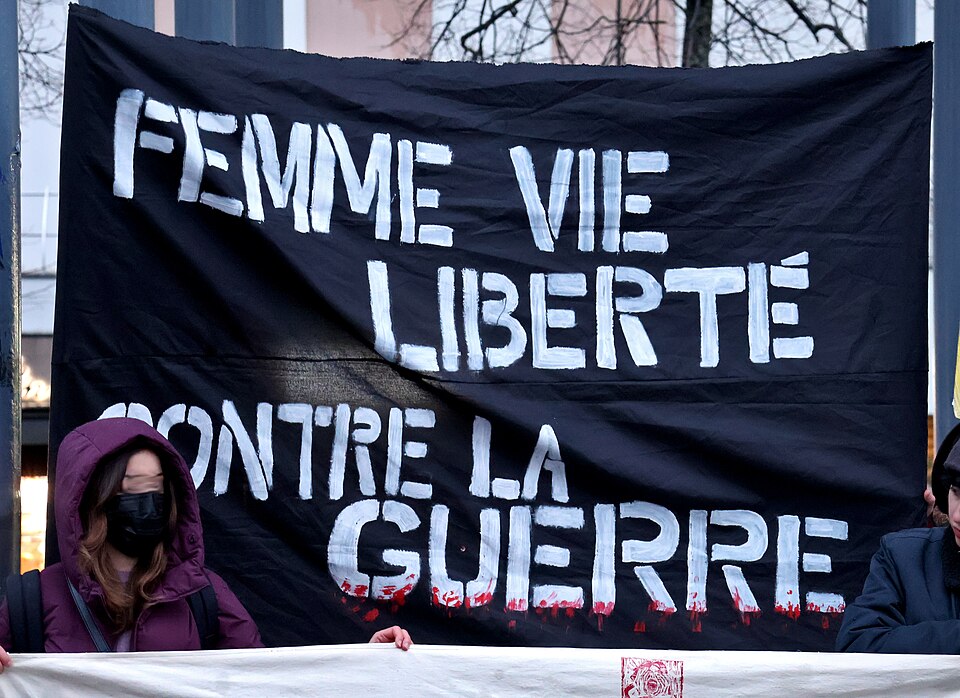
Shahabi is sharply critical of attempts by the U.S. government—and by monarchists who hold disproportionate media and political dominance within the Iranian diaspora—to exploit Iranian opposition struggles such as the Woman, Life, Freedom movement for their own ends. He warns that such attempts don’t reflect the diversity of Iran’s internal opposition or diminish the validity of its grievances. “We don’t have to prove that our suffering is pure enough, or that nobody in Washington can ever exploit it, before we’re allowed to talk about repression in our own country. Of course the US exploits real grievances. Empires do that all the time. But that doesn’t make the grievances fake, and it doesn’t make Iranian people responsible for how the US chooses to use them.”
3 – The Islamic Republic feeds off of external threats and attacks.
The Islamic Republic of Iran, Shahabi writes, is “a regime whose very existence has been built on surviving in a state of war. This system has no meaning without an enemy. From the 1980s to today, it has consistently maintained the image of a foreign threat in order to suppress domestic dissent.” And this dependence on threats isn’t just ideological. Shahabi describes the Iranian economy as “security-state capitalism”—a system in which Iranian elites profit not only from enforced working-class submission but also from foreign sanctions that serve as a protective wall insulating Iranian businesses from foreign competition.
4 – Campism is rooted in colonialist attitudes more than in Stalinism.
Campism—here meaning the ideology that condemns U.S. or western imperialism and applauds all regimes ostensibly opposed to it—is often seen as an outgrowth of orthodox Communism and the Cold War. Shahabi questions this explanation, noting that some campist organizations don’t have Stalinist roots while some with Stalinist roots are relatively critical of the Iranian regime. “The deeper problem,” he suggests, “may be the survival of a colonial relationship inside the left itself, one where the European still keeps the right to interpret the other, even when doing it in the language of anti-colonialism.” In this worldview, Shahabi argues, “Other societies aren’t seen as societies with their own conflicts and contradictions. They are understood mainly through their position in relation to the West.”
As background, Shahabi cites Aimé Césaire’s 1956 resignation from the French Communist Party. Although Césaire was partly spurred by the Soviet Union’s suppression of the Hungarian Revolution, he also, writes Shahabi, “objected to the idea that a European political center could place the struggles of colonized people inside some ‘larger whole,’ then decide for them which issues were primary and which were secondary.”
* * *
These notes don’t capture the full range of Shahabi’s writings. In some essays he offers details about the current situation in Iran that are hard to find elsewhere, such as an October 2025 account of the hijab law’s status following the Woman, Life, Freedom movement; in others he’s less concerned with arguing a position than with sketching a person in their complexity, such as his reflections on the death of Persepolis author and director Marjane Satrapi. Siyâvash Shahabi’s work has a lot to offer, and I encourage you to check it out.
Photo credit
“Woman, Life, Freedom / Against the War”: banner at a rally in solidarity with the people of Iran, Paris, 13 March 2026. Photo by FreCha. CC-BY-SA-4.0, via Wikimedia Commons.