Joan Braune Interviews Esther Warwick, Executive Director of Disability Communities Defending Democracy
By Joan Braune
Over the past eight years, I have learned a lot from Esther Warwick about how the far right infiltrates disability spaces and about far-right ableism. We talked about how Warwick has seen the relationship between disability movements and the far right evolve over the past decade.
Warwick and I also discussed how eugenics has influenced laws, past and present, that lead to institutionalization or forced labor for people with disabilities and people experiencing homelessness.
Warwick and many other disability rights activists have condemned Robert F. Kennedy, Jr.’s “Make America Healthy Again” (MAHA) project as harmful, and it has concerning resonances with past policies in American history.
Eugenics in American history is not found only at the far-right “extremes” but was once a mainstream policy position. In the early twentieth century, a number of states passed sterilization statutes mandating forced sterilization of the “feebleminded,” and this was upheld by the Supreme Court decision Buck v. Bell in 1927, which ruled that states could mandate sterilization of specific populations. Feeblemindedness was an elastic category that could be used in various respects, including frequently being applied to women who were deemed promiscuous.
Early twentieth century eugenics laws coincided with restrictive immigration laws targeting particular ethnicities. American eugenics and “race science” worked hand in hand. One of the most insidious early twentieth century texts of American white supremacy, Madison Grant’s 1916 The Passing of the Great Race, advocated for a form of eugenics beginning with curtailing the reproduction of “the criminal, the diseased and the insane” and then expanding to include Blacks and possibly other minorities (Quoted in Kay Whitlock and Michael Bronski, Considering Hate: Violence, Goodness, and Justice in American Culture and Politics, 26). President Theodore Roosevelt praised this racist book.
Disability has frequently been paired with racism and perceptions of criminality in American history. American eugenics and “race science” also helped pave the way for Nazi atrocities, providing a framework for Nazi race laws.
Braune: Thanks so much for taking the time to chat with me. You’ve been thinking about intersections between disability and the far right for a long time. Thank you for getting me on this issue.
Warwick: I’m very pushy about it, yes.
Braune: Which is great. I think disability is really underexplored in terms of thinking about antifascism and fascism. Maybe you could tell us a bit about your new project, Disability Communities Defending Democracy, and how it got started.
Warwick: So, this is a continuation of work that I have been doing for many years. I was noticing in my community, the autism community, the spread of fascist discourses and the spread of anti-democracy groups, particularly with the capture in anti-vaccine movements; in autism parent communities; the rise of incels in communities of autistic people, particularly young men and boys; and the fetishization of autism by the alt-right and participation of autistic people in the alt-right. Several alt-right leaders identified openly as having Asperger’s syndrome, such as Traditionalist Worker Party leaders Matthew Parrott and Matthew Heimbach.
I was noticing these trends on the ground in my communities and online, and I was very disturbed by the rise of fascism. I was in high school when Gamergate happened, and there were fascists in my high school, and there were fascists at my college. When Trump got elected, I was very concerned about the rise of fascism and what that would mean politically, and not just in electoral politics. So, I figured, fight them everywhere they are.
I was involved in the disability and autism communities, and it was in that niche that I wanted to organize people. I started back in 2018 with a Facebook group called “Autistic Counter-Recruitment,” based on the idea that we should go out and talk to Nazis and try persuade them not to be Nazis, or spread propaganda about how being a Nazi is bad and you should be on the left instead. The idea was to make the case to people that the fascists are lying to you, that the left is the way that we will get liberation, and that racism is bad for the working class, which is true.
I have since evolved in my understanding of how we confront fascism and white nationalism, but it really started out as this research group. I was one of the more active members, and I started presenting on what I was finding. I had been interviewing people I knew who had been involved in some way with the alt-right—people who had been friends of mine, who were not friends of mine for a good period of time because they were openly involved in white nationalism, and who had then broken with white nationalism. I started presenting on that in community groups, including at the Autistics Present Conference. Like many autistic people, I just kept perseverating on this issue. But also, it’s very topical. Then in 2020 I got a fellowship with Western States Center that led me to look more broadly at disability communities and what we were dealing with.
There were several incidents in the Trump 1.0 era where people in disability communities thought that we could move forward on disability rights or stop attacks on Medicaid by exploiting anti-immigrant and white nationalist discourses.
For example, there was a fortunately very reviled incident of a disability leader who was brainstorming on a livestream while sitting in a politician’s office—occupying it in protest, actually—making the argument that, “Well, if we just say, ‘Democrats, you care more about immigrants than people with disabilities in our own country,’ we could get some Republicans on our side” to support a particular bill. And this was a highly respected leader. Anti-immigrant discourses were not uncommon, particularly if you were on the right wing of disability communities, and there is quite a bit of a right wing in disability communities. Many people are only familiar with left-leaning disability organizations, or they don’t think about disability organizations as having left or right politics, which is not true.
Braune: Do you think that people underestimate how political the disability rights space is, because they view disability organizations as charities and depoliticize them that way?
Warwick: Exactly—there’s not a lot of politics associated with it in people’s minds. It’s a charity model. It’s a medical model. There’s not a lot of understanding of political disability, and when there is an understanding of political disability, it’s assumed to be on the left—kind of inappropriately. Even the radicals in the disability community have a lot of heterogeneity in their political ideology. We’ve got a lot of very right-wing libertarians, for example, making a lot of our theories and discourses around what institutionalization is and why it’s bad.
Braune: Why do you think there are so many disabled right-wing libertarians? Is there recruitment of autistic people or people with disabilities in general into libertarianism?
Warwick: I think so. There’s a lot of participation in libertarian communities among autistic people. You see autistic people and other people with disabilities more attracted to non-standard or non-dominant political ideologies, simply because we are pushed to the margins of society.
Unemployment rates among people with autism, youth specifically, are very high. The best data I’ve found is a survey done by Drexel University. I think it was in 2014. It found a 50% unemployment rate among autistic youth. This was during a fairly good economy. Under-employment is extremely high among autistic people and people with disabilities, and the types of employment that people with intellectual disabilities and other types of developmental disabilities have, get sort of separated from the rest of society. You may be allowed to work in an integrated job with competitive integrated employment, but it might be very reduced hours, and you might have a “handler” or job coach with you. I am a very strong supporter of competitive integrated employment, but often people are in a segregated environment, like a sheltered workshop, sometimes earning pennies on the dollar, in the states where it is still legal to pay disabled people below minimum wage.
We talk about how, for many people with intellectual and developmental disabilities, your life is that you go from your “special school” to your “special home” to your “special job,” and your whole life is “special,” but what’s really special about it is how you are treated especially badly.
So, I think there’s a lot of reasons that people do not want to be a bog-standard liberal or conservative.
There are many people on the left who identify as neurodivergent, who identify as having a disability, to the point where disability is almost seen as sort of a leftist thing inherently by both the left and the right. There’s also a lot of people who get really into the right or very attached to certain conspiracy theories because the fearmongering about “totalitarianism” makes sense to their lived experience, because they’re being controlled by people all the time.
Braune: Yeah, that’s such a good point. And I think with those unemployment rates, if you’re unemployed and sad, it makes sense you would spend a lot of time on the internet and build little ideological communities or bubbles around yourself. I would assume, for a lot of people, it’s a way to connect, and people online don’t have to know you’re unemployed or disabled if you don’t want to tell them.
Warwick Yeah, and you have to also understand, people with social disabilities such as autism, but with any experiences that lead them to be segregated from other people, particularly if they’ve been through self-containedspecial education programs, may lack social skills. They were never given the opportunity to develop them, and that leads to severe isolation. They don’t get to make friends, and they might now be able to get on the internet, because now people can get on the internet with their smartphone. I found a lot of self-advocates—we call activists “self-advocates” in the intellectual and developmental disability community—really loved TikTok, because they didn’t have to write super well, no one would make fun of them for their grammar online, and they could just speak into their phone with what their opinion is and scroll videos. Short form video is very accessible but has lots of misinformation.
Braune: So, at the height of the pandemic in 2020, there’s this rise of people being even more online and more conspiracy theories about vaccines and so on. How did your project develop in the wake of these shifts during Trump 1.0?
Warwick: In 2020, for the project with Western States Center, I was giving these talks about autism, the alt-right and discourses on the right about disability, and what sort of factors can make organizations more susceptible to fascist entryism. I was seeing how that applies to my disability communities and where the cross-pollination with fascism is happening. A lot of that cross-pollination is through anti-vaccine activism. Many disability communities are very into alternative medicine and are anti-vaccine, including autism communities, because there’s a lot of cross-pollination between anti-vaccine autism parents (who believe autism is caused by vaccines), autism parents generally, and autistic self-advocates.
During the Western States Center fellowship, I started working at a disability rights organization, seeing this cross-pollination in real time. I was working for a parent-led organization that was very progressive, but it still was in that milieu where there were intersections with the right. The people in my community were getting further and further to the right, largely in response to the very real challenges of isolation and control over their lives during the COVID-19 pandemic. For many people without disabilities, the whole “lockdown” phase was less than a year. But for people with disabilities in my state who lived in group homes, state-operated living alternatives, and also institutional environments [residential habilitation centers, nursing homes, and intermediate care facilities, etc.], leaving your home was not allowed at all for over a year. You had to mask in common space, and some people could not physically wear a mask. If you lived in the community and you could not physically wear a mask, you would sometimes get harassed about it.
People with intellectual and developmental disabilities, a lot of autistic people in particular, people who were being restricted in their daily lives and weren’t allowed to see their family, weren’t allowed to see their friends, weren’t allowed to go to self-advocacy meetings, weren’t allowed to use a computer as per normal to be able to use the internet to talk with people. This is a long-standing issue in disability services, not giving people support to be able to use technology for meeting with their friends. Figuring out Zoom was very difficult for people, especially people who weren’t really taught basic literacy skills in school. There were a lot of real restrictions placed on people for a very, very long time. People were worried for their friends. People were worried for themselves. The anti-lockdown, anti-mask part of the right exploited very real challenges. When I was in self-advocacy meetings, I would see people’s right-wing anti-mask Telegram chat notifications, while they were hosting a meeting about a progressive advocacy bill.
There was already a lot of cross-pollination in disability self-advocacy with the anti-vaccine movement, the anti-abortion movement, and to a lesser extent the anti-assisted suicide movement. Some national disability rights organizations have often historically aligned with the religious right on these issues, sometimes getting funding from them; many organizations don’t take positions on certain issues due to antichoice donors. So, it was a political moment that was very good for getting a lot of people into hardcore fascist movements and ideology.
I continued doing this work, and in 2024 I was approached by a funder from the Ford Foundation who has been very concerned about this. She talked about how she saw wheelchair users at January 6[the 2021 insurrection at the U.S. Capitol], had known in her community about male supremacy issues and people being very racist, and saw a problem that someone needed to solve. She was searching for the type of people who were going to solve it. She talked to me, and I explained what I’d been doing, and she eventually invited me in for a grant. In 2025, I got all the paperwork in for Western States Center to be a fiscal sponsor. They’re great, love their work. And over the past year, I’ve just been getting things prepared and moving forward with starting to do education on these issues and aiming the education to where the foundations need to be built for the communities that are most targeted by the right, which is the intellectual and developmental disability community. That community is particularly targeted by the right because of its prevalent anti-abortion politics, particularly within the Down Syndrome community.
Fascist Eugenics and Persecution of the Homeless
Braune: I wonder what other trends you are seeing with fascism and disability that people might not know about. One of the things that comes to mind for me is homelessness. I think I had a discussion with you at one point where you mentioned the ugly laws, in reference to Louisiana now trying to incarcerate people for being homeless. I don’t know if you have more thoughts on that.
Warwick: We’ve been in bad moments on disability before. The rise of institutionalization was a project. That was done to professionalize the segregation of disabled people from everyday life. Later, that was tied with the eugenics movement, to segregate disabled people, so that we could not pass on our “bad genes,” and that was intimately tied with forced sterilization and forced labor, which were also an issue in these institutions. They were horrible for people and billed as the correct place for disabled people to be.
The “ugly laws” came about during a sort of national panic about disability and about disability fakerism, particularly among homeless people. This was right after the Civil War. A lot of people were freshly disabled from the war, and industrialization created new disability experiences—which is a great euphemism for, people got their arms caught in the cotton mill and they couldn’t work anymore, or they were blinded by a mining accident, or something of that nature. So, you had a lot of people begging on the streets, and many of them claimed to be Civil War veterans, because there were a lot of disabled Civil War veterans at the time. The upper middle class wanted to instill order. There was also this panic around gender and sexuality that was coming about in these cities, particularly in San Francisco, where the first ugly law was created in 1867. It’s a very similar type of situation as now, where there’s all these panics about gender, sexuality, race, and so on.
Braune: Was San Francisco’s law framed around wanting to hide people with disabilities, or targeting LGBTQ+ people, or both?
Warwick: It was created around the same time as anti-cross-dressing laws and anti-Chinese laws. They wanted the city to be for a specific type of person, and they wanted to get rid of people who they found to be “unsightly,” which is the language used in the original ugly law and in the Chicago ugly law. They didn’t want to be confronted with people that they didn’t want to see. There was this huge disgust response when they saw a person with a disability, particularly showing their disability to say, “Look, I can’t work,” or “Look, I’m maimed, and please have some mercy and give me some alms.” For that they’re, like, “No, you should be sent to an almshouse.” They wanted to make it a crime for rich people to be made to feel uncomfortable. This is exactly what we see in anti-homeless propaganda today, like Komo News’s anti-homeless propaganda movie Seattle is Dying. It’s exactly the idea that these are people who shouldn’t be seen on the streets, who are making things unsafe. The San Francisco law was also tied to drugs, this idea of “vice” that was happening; there’s really a recycling of these discourses. In the ugly law, the people who were found to be begging on the streets and were deemed to be “unsightly”—that is, showing their disability—were to be arrested and taken to an almshouse or an institution. That is exactly the proposal that we have seen in many Democrat– and Republican–run states and cities recently, saying we need to sweep people up and take them away from our cities, so that we can beautify our cities.
Braune: This is really, really helpful historical context for people. Can we connect this to what is going on now with Robert F. Kennedy, Jr., current U.S. Secretary of Health and Human Services? This theory is not original to me—I first started thinking about this thanks to a video by Sarah Taber—but basically, the question is, who is going to farm if all the migrant laborers are deported?
Somebody’s going to have to farm, and in the past sometimes that’s been formerly enslaved Blacks who were incarcerated and re-enslaved as convicts under the thirteenth amendment’s loophole, which allows slavery for those convicted of a crime. Formerly enslaved Blacks were charged with things like “vagrancy”; if you think about it, vagrancy can be homelessness, or even just sort of “hanging around without a job,” which is exactly what one would be doing if one had recently been enslaved and the war had just ended.
Maybe capital is going to be looking for a new way to force people to do these farm labor jobs today. When we hear RFK, Jr. or others in his “Make American Healthy Again” (MAHA) movement making claims about farms or nature being “healing” for people with disabilities, could this be part of what’s happening?
We are currently seeing a push to put homeless people outside of towns in special places. For example, Utah is building some sort of special farm or camp for homeless people.
Warwick: A work camp.
Braune: I mean, the World War II alarm bells are ringing off the hook for me.
Warwick: Like, “Arbeit Macht Frei,” “work makes you free.”
Braune: Yes, exactly. Do you think we are going to see homeless people, people with disabilities, or people who just need health care that they’re not going to get, possibly being forced to farm under this current administration?
Warwick: That’s something that happened historically. In the eugenics era, institutions were racially segregated. They would lease out Black residents to white families to work as servants and to basically be slaves in fields. White residents would be made to work on the dairy farm and other things, because they thought it was curative. These institutions were often in rural environments, because the idea was it would be therapeutic. It was also, you know, away from people. People were hidden away in these rural environments, in “cottage-style” institutions built in the 1910s, ’20s, and ’30s, many of which are still operating today.
Braune: Putting people way out in rural environments makes it easier to hide abuse too, like with “troubled teen” wilderness camps.
Warwick: Plus, it provides jobs, right? The institutions are very important for the local economy. There’s this faux paternalistic mindset. We’re seeing a resurgence of this in the private institutions—these “autism farms,” as they literally call them. The idea is, send your adult child to these places, we’ll care for them, and they get to do farmwork, and it’s going to be so good for them. The farmwork is probably more branding than anything; they’re probably not really being asked to make a profitable farm for most of these places, but they’re trying to get federal funding for this, and the feds have been pretty consistent in saying that these farms would be institutions, and that you can’t use Medicaid dollars for institutions. But the MAHA wing of autism and the people who are fighting for this label of “profound autism” or “severe autism” are very for institutions, and they have the ear of RFK, Jr. So, we’ll see what happens to those rules. So far, we haven’t heard anything about that changing, but clearly RFK, Jr. is a big proponent of these “cottage-style” institutions.
It’s such a popular idea lately on the right that we’re trying too hard to educate certain whites who really should just be doing hard labor, that too many people are going to college right now, and that it’s bad for everything, because they’re also learning about feminism and stuff like that. They believe that there’s this natural population that really should be doing all this hard labor, and if we get them to do all this hard labor, they’re going to feel better; it’s going to be better for them, and they’re going to live in a whiter society, because their labor can replace the labor of the people of color who will be deported or confined.
This is obviously not an actionable plan, but this is the fantasy that these people have. I think they’re really talking about people who they think of as having learning disabilities. Basically, they think people with dyslexia shouldn’t be taught to read—they should be given a shovel.
Fascists, Disability, and the Three Way Fight
Braune: Wow. As we start to wrap up, I would like to put this a little bit in the context of antifascist strategy. You’ve shifted your approach from the time when you were doing the 2018 Facebook group and you were thinking about counter-recruitment. Now you’re focused on inclusion of disability within antifascist organizing and disabled antifascist activists. You seem more focused on setting boundaries with the far right, rather than counter-recruiting the far right. When we think about the concept of a three way fight, for me that includes the idea that we are not only up against fascists but also up against a broad system of policing, that includes counter-terrorism think tanks and “soft-power” government-funded organizations aimed at “preventing violent extremism.” We are not going to solve the problem of fascism by relying on policing, whether that’s naively hoping we can solve the problem by waiting for cops to arrest the Nazis or expecting these state security–funded institutions to prevent fascism through “deradicalizing” people.
Warwick: What I realized about “deradicalization,” or counter-recruitment, is you really can’t reach these people unless you make being a Nazi suck. If you’re a street Nazi who’s trying to stab people, part of making it suck for you is you get doxed or antifascists come at you with bats. Now, in the field that I work in, we’re not telling people with disabilities to go out there with bats, but what we are saying is you should structure your organizations to be more inclusive of people with disabilities that are not like yours, more inclusive of people of color, more inclusive of LGBTQ people—everyone that your local Nazi hates. We need to militantly defend folks. And we need to be giving people resources on how to effectively respond to folks trying to take over your group. We need people to be able to challenge far-right ideas, to call them out for what they are, and be very real about why it is unacceptable and incompatible with disability rights and disability justice.
Braune: Make being a Nazi suck, and that is counter-recruitment, in a way.
Warwick: If you’re in the process of becoming a Nazi, it’s very important for you to still maintain your community ties and to push the envelope continually, and it’s important for you to get power over narratives and over groups. And if you’re shut out from that process, you may think twice.
Braune: So that it just becomes impossible, because everywhere you turn, anything you try to do that’s a Nazi thing, you just can’t, because you are stopped from all directions.
Warwick: Yeah. The idea is, if you are pursuing goals that are counter to what we might call inclusive democracy, it should kind of suck for you, because that’s a horrible thing to do. These deradicalization programs want to make it really, really nice for you, to try and coax you out, to make you realize that you should be feeling warm butterfly feelings whenever you see someone who is not like you. That’s just not how it works.
Braune: Yeah. And this approach is also about annoying fascists by making the gains that fascists don’t want you to make, right? I feel like you’re not giving in to frantically responding to every fire they set—you have a radical vision of liberation for disabled people, and you’re also just pursuing that vision at the same time, right?
Warwick: Exactly. I am currently working on a toolkit on antisemitism, which is probably going to come out next year. It addresses why antisemitism is counter to the values of the disability movement, and it really centers on the inherent humanity of Jewish people and how respect and diversity are consistent with our values in the self-advocacy movement. The disability movement is very anti-eugenics and anti-ableist. That’s how I’m grounding the discussion to then talk about what a conspiracy theory is and how that ties to eugenics, and how it is a threat to all social movements to have an incorrect view of who has power—not a secret Jewish cabal but capitalism.
Braune: As we close, is there anything you want to add that it’s important for people to think about?
Warwick: I think in terms of trends in fascism, it’s really important to understand that we were in this moment ten years ago, where there were a lot of heterogeneous views on disability on the right. That’s where I started with my project, explaining all the different ways that the right viewed people with disabilities. But this all really coalesced in the Biden era, towards outright hatred of people with disabilities, and towards identifying disability with the left and identifying disability as an enemy within the country that it was necessary to eliminate. Now this has been challenged a little bit by the inclusion of the MAHA movement, RFK Jr., and his weird crowd of anti-vaxxers in the Trump administration. We’ll see how that affects policy and rhetoric. But overwhelmingly the right’s rhetoric has turned towards outright hatred and hostility towards people with disabilities and glee at being able to say the r-slur, for example, and adopting a complete “we should just kill them” sort of idea, or that people with disabilities are dangerous. So, it’s very similar to how they talk about unhoused people, which has always been intimately tied with discourses on disability.
Braune: Thank you so much for your time. That was fantastic.
Warwick: I’m glad I got to talk to you about horrifying things once again.
Braune: Absolutely, me too. Thanks for studying horrifying things and for the work you’re doing.
Joan Braune joined the editorial board of Three Way Fight this spring. She is a community activist, educator, and Senior Lecturer in Philosophy, based in Spokane, Washington, USA. She is author of Understanding and Countering Fascist Movements: From Void to Hope(Routledge 2024), among other works. She also serves on the editorial board of the Journal of Hate Studies.
Photo Credit:
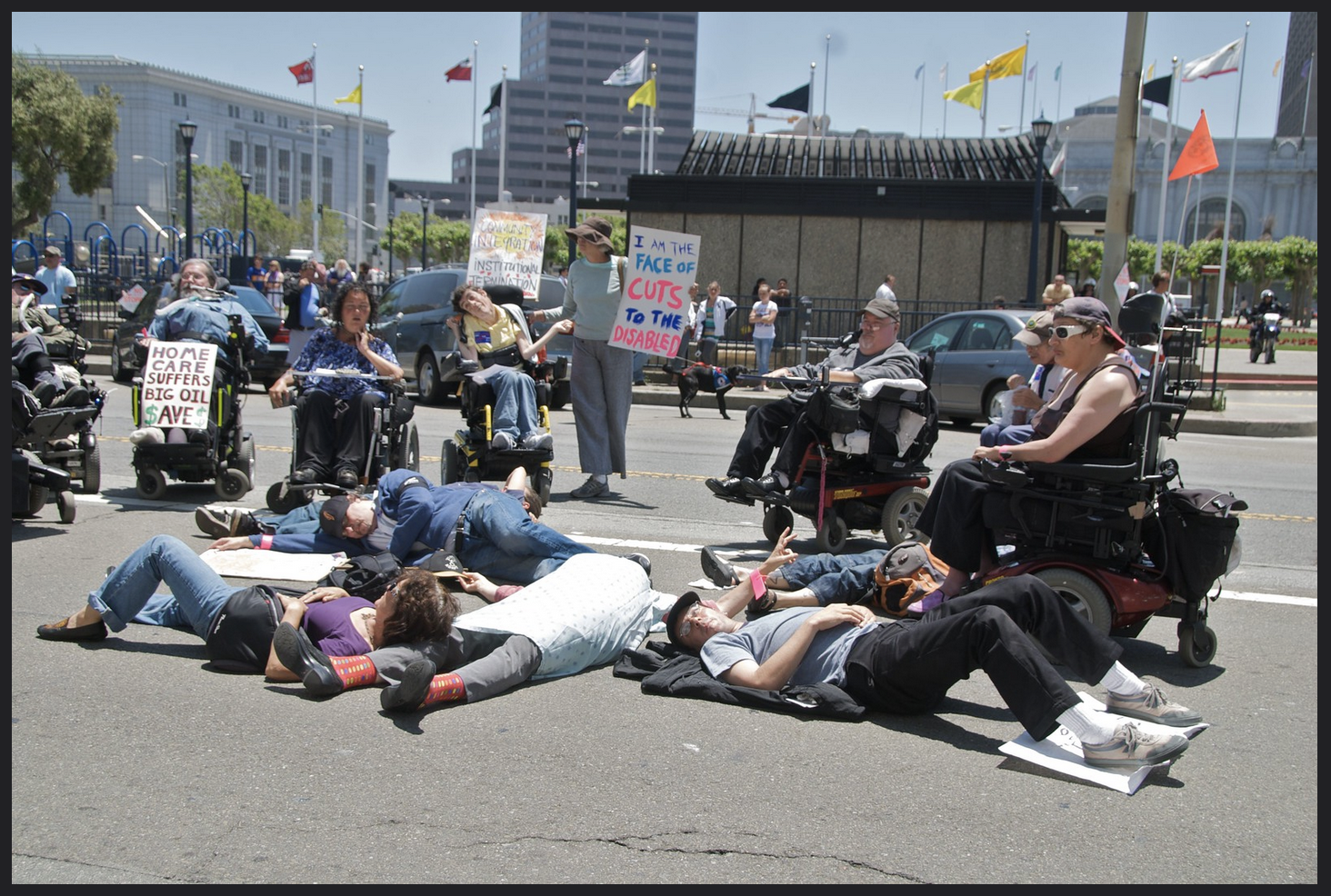
Steve Rhodes, Disability rights activists risking arrest to protest cuts in front of State of CA building (June 2009), Creative Commons license via Flickr.