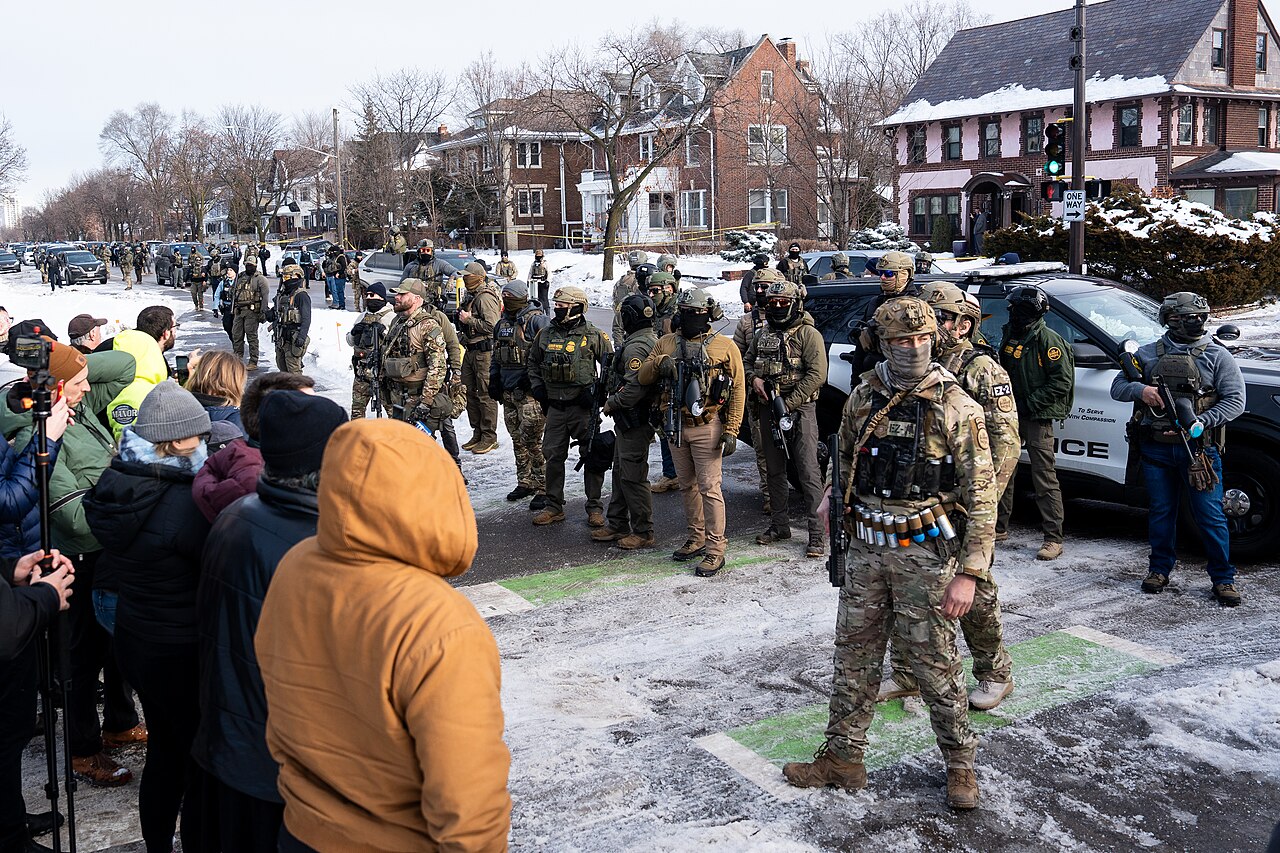
What the F**k Is to Be Done?
Some Thoughts on Strategy
By Dandy Andy
Although i am a Canadian, i have chosen here to focus on the US for two interconnected reasons: (1) the ascendancy of the far-right throughout the European world has reached its clearest expression in the US; (2) the way in which the current crisis in the US unfolds will have a major impact on how the far right evolves elsewhere.
We can already see ways in which the second Trump victory has affected the far right elsewhere in the world. In Canada, for example, prior to the second Trump victory, Pierre Poilievre’s Conservative Party of Canada, which i would categorize as Trumpism lite, had been poised to potentially take over the federal government. However, in response to the tariffs and the annexation talk, it instead found itself scrambling to create distance between itself and Trump and his administration. The crisis the Conservatives faced provided the opening that allowed Mark Carney, a mainstream old-school neoliberal, to take control of the Liberal Party, which under Justin Trudeau had been a vehicle for a more socially liberal form of neoliberalism with a thick patina of pro–identity politics posturing. Once in power, Carney proceeded to enact a series of policies and a budget that differed in no substantial way from what the Conservative Party had been proposing. The only real difference was that Carney steered clear of Poilievre’s hateful rhetoric. The outcome is steadily deteriorating conditions for marginalized groups and for society at large. As a strategy it has been successful in tamping down resistance overall, and should Carney run again, he is likely to win based on little more than a visceral fear of what a Conservative government would mean. Even were Carney to step aside, which is not entirely unlikely, as he is not a politician in any ordinary sense but a neoliberal technician, and he has largely achieved his goals, the Liberal Party would still face no serious challenge.
I offer this appraisal of the impact of Trumpism on Canadian politics as an example because it is the one i am most familiar with. A similar assessment could obviously be made regarding the impact of Trumpism on the far right in almost any other country in the world, but that is not my purpose here, so to my point.
The Primary Contradiction
An issue keeps arising in conversations with comrades from different scenes. How do we craft an anti-capitalist strategy for our current period? As i attempted to formulate an answer to that question, i found myself ruminating on my fifty years of experience on the far left and the lessons i had learned in various campaigns over those years.
Lenin argued, i think correctly, that at any point in history there is a primary contradiction around which oppositional politics must be organized. For Lenin that was the contradiction between the working class and capital and the related imperialist conflict between capital and the colonies. While both of these conflicts still exist, within advanced European societies the centrality of the conflict between the working class and capital has shifted substantially as a result of technology and a new international division of labour, as well as the neutering and, in some cases, elimination of the traditional bodies that organized and defended the class, specifically the unions, social democratic and communist parties, and anarcho-syndicalist organizations. As this conflict receded, other social conflicts moved to the forefront becoming, in effect, the primary contradiction of their time, serving as a point of reference for organization and struggle. As such, at any point it behooves us to identify the primary contradiction and make it the focal point of our struggle.
“While the attack on migrant communities is currently playing out as the primary contradiction, it is not the sole significant contradiction, and our understanding of it must be nestled within a larger analysis of the overall crisis created by the ascendency of the far right.”
Within the US, it is currently the military attack being carried out against migrant communities. This attack has been met with strong resistance from the communities targeted, including people in those communities who are not migrants and, therefore, don’t face the same level of collective risk. However, this resistance has not, as yet, clearly made the link between this struggle and the complex and contradictory capitalist interests that underlie it. The role of the left in this context is to introduce just such an analysis, but to do so through respectful dialogue as participants working as equals alongside other participants. This is a long-term process of solidarity and trust-building. The long history of left-wing groups parachuting into other people’s struggles with leaflets and newspapers and instrumentalizing struggles as recruitment exercises has left many people with a healthy wariness about the left’s motivations. While we should never hide our politics, we should recognize that there are numerous systemic barriers to our ideas, and these barriers will not be overcome in rhetorical debate. Only genuine commitment and solidarity, as well as a tolerance for disagreement, will lay the basis for a dialogue around politics that posit an alternative to capitalism, a concept currently far beyond the reach of most people’s imagination. In our current conditions, the long-term process of creating the necessary ideological shift may initially largely be a case of exhibiting a willingness to do the necessary grunt work of movement building, thereby creating the conditions in which people will be open to hearing us.
It is also important that we not lose sight of the fact that while there will generally be a central conflict, there will often be more than one apparent flashpoint of intense conflict. For example, while the current primary focus is the ongoing and systematic (as well as systemic) attack on migrants, a related but nonetheless discrete attack is being carried out by far-right Christian tendencies that have infiltrated the state and its institutions in a highly organized forty-year campaign. While this section of the institutional far right is entirely on board with the anti-migrant campaign, its primary focus is on shaping a social structure based on imagined halcyon days of yore, most clearly represented by a putative “traditional family.” From the seventies onward, this tendency has been central to attacks on women’s rights, particularly the right to free and safe abortion on demand, and on LGBTQ+ movements, as well as being behind the satanic panic of the eighties, which targeted artforms, particularly in rock music, that challenged “traditional” social mores.
“Only genuine commitment and solidarity, as well as a tolerance for disagreement, will lay the basis for a dialogue around politics that posit an alternative to capitalism.”
In recent years and, since the first Trump victory in 2016, with increasing success, this tendency has focused on seizing control of educational institutions and shaping the nature of education, replacing science with religious myth, challenging accepted health protocols, including Covid-era measures and vaccination in general and attacking trans-affirmative medical therapy, and opposing all elements of DEI. Its most noticeable tools have been school and library book bans meant to erase all expressions of LGBTQ+ reality and any positive portrayals of non-white cultures, particularly Black Americans and Muslims, as well as any critical examination of US history. Its foot in the door is an attack on trans and nonbinary rights, drag queen story hour being a key flashpoint, with the rhetoric and actions of the satanic panic campaigns being retooled. Using the approach it has used in all previous campaigns, this movement posits its attack as a defense of children, who must be protected from anything that undermines the traditional family or contradicts a particularly vindictive far-right (and intensely contradictory) reading of Christian values. The manipulation of the need to protect children—even, in the case of trans children, from themselves—has a long history as a winning strategy for the far right. In the case of the attack on trans people, political opportunism and retrograde dogmatism have won this movement the support of certain sections of the women’s movement, the so-called TERFs, and of a vociferously anti-trans LGBQ movement.
Taken together, these two sometimes overlapping but partially distinct movements provide the basis for and are instrumentalized by far-right campaigns spanning the spectrum from the Heritage Foundation’s Project 2025 to The Base’s accelerationist neo-Nazism. They, therefore, provide an initial point of reference for building a left-wing response to the growing right-wing social hegemony.
So while i argue that the attack on migrant communities is currently playing out as the primary contradiction, it is not the sole significant contradiction, and our understanding of it must be nestled within a larger analysis of the overall crisis created by the ascendency of the far right. At some point, one way or another, this campaign will run its course, but the conflict with the far right won’t. One of the other already smouldering fronts in this conflict will come to the fore, presumably spurring another round of resistance. If we have not managed to create a persuasive analysis of the overall far-right agenda with a certain degree of mass appeal, the resistance in one area will likely fade, and a new process of movement building in a new area will be necessary, with little or no cohesion or net growth in overall resistance.
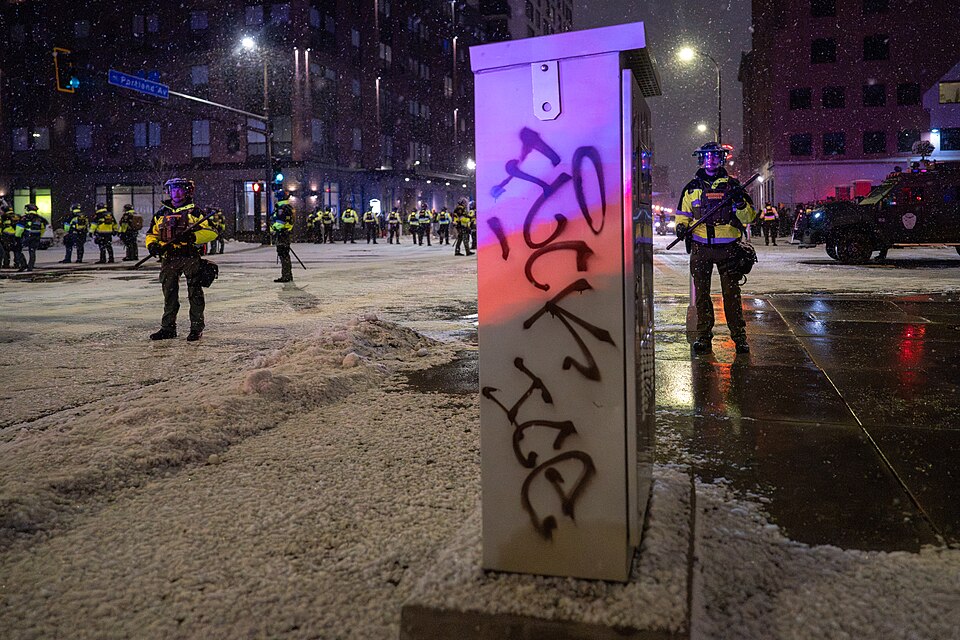
The Role of Intersectionality
Intersectionality provides part of the answer to this dilemma. While the major conflict with capital and the state is currently the attack on migrants, migrant communities and their supporters include people who are currently targeted in other areas. There are clear ways in which Islamophobia crosses over with anti-migrant sentiment; in fact, they are basically conjoined twins. The attack on women’s rights, e.g., the overturning of Roe v. Wade, also affects migrant women, just as the attacks on LGBTQ+ people affect LGBTQ+ migrants. Migrant communities include Black people who experience the same white supremacist attacks as African Americans, and the attacks on DEI affect every group mentioned here. Everyone suffers from the destruction of the health care system. The AI and surveillance systems being used to track migrants are an element in the construction of a panopticon that will eventually encase us all. Correctly managed, any single conflict opens the way to an analysis and strategy that encompasses all areas of oppression.
This returns us to the issue of class, often overlooked when the intersectional model is applied. This is in no small part because intersectionality rose as a corrective to the idea that gained a certain traction in the sixties and seventies that resolving the conflict between the working class and capital would de facto resolve all other issues, a vulgar Marxist distortion of fundamental dialectics that made the oppression of the working class the central social contradiction, with all other oppressions secondary in nature, while the truth is, in fact, the inverse. At the end of the day, all oppressions manifest at least in part as class oppression: the wage discrepancy between men and women doing the same job; the massive unemployment of Blacks and other people of colour; the fact that trans people experience the highest level of homelessness and the concomitant violence; until recently, being openly gay or lesbian shut the door to career progress, and probably still does to a lesser degree; the use of migrants as cheap labour and to undermine wages overall, creating the “blame the victim” racism that we are seeing these days; ditto religious minorities; the fact that disabled people receive a much lower than average level of education, often lack the resources to acquire the supports they need, and are frequently unable to adequately house themselves; whoever i’m forgetting, because one of the problems with shopping-list categorization of this sort is that someone is always forgotten. I would argue that in our current economic and technological environment youth are an oppressed group in an unprecedented way. As such, we should be approaching each of these conflicts as part of a class struggle that arrays all oppressed communities and people in a single front against capital and the state.
Diversity of Tactics
Just as our analysis must embrace a diversity of struggles in a way that sees them as equal parts of a greater unified struggle, our practice must be open to a genuine diversity of tactics. While petitions or letter-writing campaigns directed to a far-right government might seem pointless, we should not lose sight of their propaganda value when approaching people outside of or at the fringes of the struggle, both for starting conversations and for creating an opening for integrating new people into the struggle. They may also provide a way to include people who for reasons of age, health, mobility, or vulnerability might not be able to engage in other actions but are seeking a way to participate or at least express their solidarity.
While demonstrations are generally unlikely to effect any meaningful change, they nonetheless serve a number of positive purposes in movement building. Much like petitions and letter-writing campaigns, they serve as propaganda for reaching observers. They also provide the opportunity for activists and organizations to mingle and exchange ideas. Unlike more confrontational tactics they are generally family-friendly. Furthermore, they provide a means, at least to some degree, of determining the size of the support for an issue, as well as for reaching people who might not be prepared to participate in more confrontational activities. Depending on the police reaction, demonstrations can clarify the class nature of the repressive apparatus. In this light, if there is a reason to believe that the demonstration might be subject to police attack or an attack from the far right, that should be made clear to all participants so that children, people with mobility issues, and people simply unwilling to take that risk are not caught in the crossfire. That is always a major demobilizing setback.
“The choice of a tactic is a matter of analysis; it is about choosing the correct tactic for the objective to be achieved in the existing conditions. Tactics are at the service of strategy and, therefore, never an imperative, ethical or otherwise.”
One of the areas of tension that most commonly arises when tactics are up for debate is that between strict adherents to nonviolence, generally ethical pacifists who trace their roots to the politics of Martin Luther King Jr. and the Southern Christian Leadership Conference and Mohandas Gandhi, and activists who are prepared to engage in more militant actions. We must inevitably make room for both currents in our movement. The basis of ethical nonviolent civil disobedience is the idea that it will create a crisis of conscience for the oppressive power. As a tactic, that has little or no possibility of success when resisting a committed far-right opponent. That does not mean, however, that many members of the far right’s support base will not be shaken by a brutal attack by state actors on nonviolent protestors, and, although i would not do it, i cannot deny the courage and commitment of serious nonviolent activists who are prepared to put their physical well-being and even possibly their lives on the line to resist social injustice. They must, however, also be flexible and not attempt to impose their nonviolence as a movement imperative.
The flip side of that equation is that activists who choose to engage in more militant actions or physical confrontations with far-right militants or police forces need to do so in a way that does not put other activists in jeopardy. For example, there are points when a breakout black bloc at a larger, more mixed demonstration serves little purpose beyond creating a clash with police that puts people who are unprepared or unwilling to engage in that direct conflict in the crossfire and at risk. There are numerous reasons why a person might be sympathetic to militant direct-action tactics but be personally unable to participate, including: caregiving responsibilities for children or for aging or disabled friends or family members; personal disabilities or health issues; lack of legal status; parole, probation, or other entanglements with the legal system. The ill-timed use of militant tactics can easily be diversionary and create unnecessary divisions that weaken the movement overall. That is not to say that there is no place at an otherwise peaceful protest for militants prepared to physically engage with our opponent. To the contrary, it is generally a good idea to have an organized security service ready to deal with attacks by right-wing militants and the police, both to protect the demonstration in general and to give vulnerable people the opportunity to retreat. There are numerous opportunities to engage in more militant actions at a time and place that poses no threat to anyone else.
The choice of a tactic is a matter of analysis; it is about choosing the correct tactic for the objective to be achieved in the existing conditions. Tactics are at the service of strategy and, therefore, never an imperative, ethical or otherwise.
Building a United Front
When we talk about a diversity of tactics, we are also often talking about a united front, and when we are talking about a united front, we are talking about a class-diverse coalition. United fronts pose specific problems, as they ultimately mean a coalition of left liberals, social democrats, and a spectrum of socialist, Marxist, and anarchist leftists. It is the nature of left liberals and social democrats to attempt to minimize militancy and seek compromise with capital and the state. In a situation where you are facing a far-right opponent, or in the case of the US, an opponent that is teetering on the edge of fascism, that is a self-defeating strategy. History tells us that capital and the state are only interested in making concessions of the type demanded by left liberals and social democrats when they feel threatened by a disgruntled and mobilizable population and are looking for a way to defuse opposition, a situation where throwing the dog a bone will do the trick. That is not the situation we find ourselves in.
“Our alliance with the left liberals and social democrats is an alliance with the base. There is nothing to be gained by any integration of the far left with the left liberal and social democratic leadership. Our objective has to be to move the base of the movement to the left.”
There is, however, an important caveat here: our alliance with the left liberals and social democrats is an alliance with the base. There is nothing to be gained by any integration of the far left with the left liberal and social democratic leadership. Our objective has to be to move the base of the movement to the left by creating a positive perception of our politics as a genuine option to proposals that do nothing beyond demanding limited measures that will serve to prop up a decaying capitalist system, something that is not plausible in the current context, in any case. It is not leaflets, newspapers, websites, or social media that will win people over to our positions; what is required is practical evidence of our commitment and the positive modeling of our politics in practice, and, given our current deficit, that will inevitably be a protracted and incremental process that will suffer setbacks and defeats and will require much patience and constant reassessment.
Overcoming Fragmentation
Close to four decades of neoliberalism has successfully fragmented and atomized our society, individualizing people and breaking down even the most basic social solidarity, something that is reflected in the so-called loneliness epidemic and the increasing tendency of people to conduct their lives, including their most intimate relationships, virtually, something that was heavily reinforced by the Covid crisis. Given that no solution can come from the center, the situation is ripe for a left-wing strategy. Unfortunately, we too are atomized and fragmented and currently have nothing to offer. Addressing this shortcoming needs to be a top priority, and we can only do so by actively participating in struggles in an organized and purposeful way with the goal of providing an analysis and strategy that can transform the current diffuse but nonetheless profound organic resistance into a genuinely anti-capitalist movement. While history provides us with some guidelines, there are no readymade templates. The most difficult task that we face is discarding many of our certainties and developing a strategy that will allow us to achieve our goal in what is a fundamentally unprecedented situation.
Without discounting the way in which social media and hybrid meetings that include a social media option meet the needs of people who for various reasons, including but not limited to physical distance, health issues, and disability, are unable to attend in-person meetings, if we hope to break down the fragmentation that is now hobbling our movement, we need to move more of our organizing off of social media and Signal lists into spaces where we can meet and begin to know each other as human beings, something that is absolutely essential to building the mutual understanding and trust required for revolutionary action. There are clear limits to the kind of action one should be willing to engage in with people who are effectively strangers. This means that we need to begin to build movement spaces: cafés, restaurants, bars, art and performance spaces, and community centers. Meetings, as painfully tedious as they can be, are essential, but real movement building and an organic process of mutual education happens when we socialize, eat and drink together, take in an exhibit, a play, a film, or a concert together, just kick back and talk about everyday shit and get to know each other with all of our strengths and weaknesses, foibles and faults, all of the things that make us human to each other. You can’t learn to love an internet avatar, and part of building a revolutionary movement is modeling the society you hope to achieve. Nothing is more attractive to someone searching for change than a warm and welcoming environment.
Public left-wing meeting places also serve another important function in our movement. They provide a destination for people new in town and for comrades passing through from other areas within our country and from other countries. To build a movement for revolutionary change we need to build contacts both within our respective countries and with activists from other countries. One of the lessons of the various socialist experiments beginning with the Russian Revolution is that Marx was correct when he asserted that revolution must be international. As such, it is essential that revolutionary politics be international. This means building genuine international structures, and the beginning point for this is to establish contact with activists elsewhere in our own country and in other countries struggling around the same issues. For example, there is virtually no country in the European world at this point where the left is not facing anti-migrant government policies and an increasingly powerful far-right anti-migrant movement. An exchange of ideas, analysis, and tactics between movements nationally and internationally can only serve to strengthen us all. While informal contact between individuals and groups based on previous cooperation and friendship is invaluable, we also need more formal structures. In spite of their many weaknesses, the national and international Marxist and anarchist structures and the international gatherings of the twentieth century did facilitate a kind of exchange that has largely faded in recent years. Given that the far-right enemy we face is well networked both nationally and internationally, it is essential that we begin to respond in a well-organized national and international way. Succinctly put, we need national and international structures of communication to share ideas, analysis, and tactics, and we need to organize gatherings that bring people together to build formal ties.
The Dilemma of Public Organizing
Finally, recent developments, from Trump’s executive order meant to criminalize anti-fascism through the Prairieland Detention Center arrests and prosecutions to the Turtle Island Liberation Front arrests indicate the intention of the state to criminalize all opposition and to use COINTELPRO-like measures to destroy it. This creates profound difficulties for movement building. It is impossible for a movement to grow without a public presence and known and approachable representatives and means of communication, including e-mail addresses, social media accounts, and often even physical offices. It is also impossible to build a genuine revolutionary movement by painting inside lines, particularly when the space inside the lines is constantly shrinking. In the existing circumstances, public activists are likely to be targeted for repression, including serious legal repression for actions carried out by groups acting clandestinely. This means that people who take on public roles need to do so with a full understanding of the risk they are taking. It also means that part of movement building is creating the structures necessary to support our comrades, whether public figures or members of any clandestine groups that might arise, when they are targeted by the state, and, once again, this is a national and international responsibility. In this case, we have many models from past struggles throughout the world worth examining. In any struggle, we need to be as serious as our opponent, and our current opponent is gambling on an unprecedented authoritarian reshaping of the world and is fully aware of what is at stake if the gamble fails. That makes for a very dangerous situation.
In Summary
There is no point in putting lipstick on this pig. We are acting from a serious deficit, and we are facing an enemy that is moving quickly and aggressively. To make up for our deficit we need to react in real time to the unremitting wave of attacks, but we cannot continue to do so in the ad hoc way we have been for some time now, arguably since the collapse of actually existing socialism in 1989–1991 and the subsequent victory of the neoliberal attack on the very basis of the social structure of society.
In responding to our current situation we need to draw upon the lessons, both positive and negative, from the strategic victories of the past, however limited and short-lived they may have been, and we need to understand our past defeats. To begin with, we need to pinpoint the primary contradiction of the period we are struggling in. This will generally be the one drawing the greatest organic resistance. I have argued that in the current situation in the US, this is the resistance to the administration’s anti-migrant campaign. We need, however, to embed our understanding of the primary contradiction in a broader analysis that pinpoints with as much accuracy as possible the numerous fronts in the struggle with capital and the state, and we need to do this for two reasons: (1) to avoid the error that would arise from any belief that the resolution of a single contradiction will be sufficient for victory; (2) to identify the other significant conflicts unfolding simultaneous to the primary contradiction, any one of which might become the future primary contradiction, and, thus, to better prepare ourselves to react when the time comes. In this light intersectionality clarifies how various conflicts interweave and interconnect into a substantive whole. In human terms this helps us to understand that each of us is oppressed in a variety of ways, no one of which is unique to us but which have a unique combination for each of us. Even our personal intersections of oppression are not stable. For example, any of the able-bodied among us could become disabled at any point, and probably will with age. Furthermore, shifts in government policy can create new oppressions that will affect some of us, the fall of Roe v. Wade is one example.
“In any struggle, we need to be as serious as our opponent, and our current opponent is gambling on an unprecedented authoritarian reshaping of the world and is fully aware of what is at stake if the gamble fails. That makes for a very dangerous situation.”
It is also essential that we develop the full spectrum of possible tactics, recognizing that the tactics chosen need to be the most effective for the situation we are facing, and that different tactics can be discretely used in the same struggle, even simultaneously. The sole consideration when choosing a tactic is the likelihood it will be successful at a particular time in a particular place, success being defined both as drawing closer to one’s objective and attracting more people to the struggle. Just as pacifists cannot expect to impose their ethical imperatives on other sections of the movement, the superficial militancy of an action should never be the determinant factor. If a tactic proves strategically ineffective, the necessary adjustment must be made.
In a period when the far left is weak, as is certainly the case now, it has no option but to enter into a united front with left liberal and social democratic forces. History teaches us that this is treacherous terrain for the far left, intense pressure always existing for it to lay aside its maximum program, the achievement of some form of communist society, to achieve the minimum goal of defeating the fascist or authoritarian enemy. Whenever this approach has been adopted, it has meant that the far left has taken much of the weight of the struggle and losses that occur therein only to see itself sidelined when the struggle is successful, laying the basis for the rejuvenation of some form capitalism, at best with some liberal window dressing that will be chipped away over time. It is essential that in any united front the left openly and publicly maintain its politics, showing both by its commitment to the struggle and the reason of its arguments that more than a return to some sort of capitalist status quo is not only possible but is essential if the cycle of struggle is not to endlessly repeat itself. Given our current weakness, this is arguably our greatest challenge.
Finally, for any of this to succeed we need to rebuild our largely decimated movement structures and radical communities, and that means moving off our computers and phones and beginning once again to build caring relations based on genuine interpersonal contact, as the basis for rebuilding our local structures, our national structures, and ultimately the international movement necessary for any victory that will be more than temporary.
It’s nothing new; it’s just the revolution.
Photo Credits
1. ICE agents and bystanders in Minneapolis after the shooting of Renée Good, 7 January 2026. Photo by Chad Davis. CC BY 4.0. Via Wikimedia Commons.
2. Minnesota Conservation Officers in downtown Minneapolis, 10 January 2026. Photo by Chad Davis. CC BY 4.0. Via Wikimedia Commons.
Don Hamerquist submitted the following comment.
Michael,
I like your essay a great deal and have some first thoughts that are heavy on quotes. I wrote most of the opening section before the recent escalation of repression. I’m including some points at the end that take these qualitative changes into account and raise some additional points…
1. “…a more liberal form of neo-liberalism with a thick patina of pro-identity political posturing…”
I think this description fits our current movement too well.
2. “…only genuine commitment and solidarity, as well as a tolerance for disagreement, will lay the basis for a dialogue around politics that posits an alternative to capitalism, a concept currently far beyond the reach of most people’s imagination. In our current conditions, the long term process of creating the necessary ideological shift may initially be a case of exhibiting a willingness to do the necessary grunt work of movement building thereby creating the conditions in which people will be open to hearing us.”
I agree that if revolutionaries want to be heard, we must be a part of the movement and share the “necessary grunt work.”
3. “…we should be approaching each of these conflicts as part of a class struggle that arrays all oppressed communities and people in a single front against capital and the state…”
True, but only if the contradictions between reform objectives are also confronted as part of a transnational class struggle around the reproduction of the species. (Kohei Saito)
4. “…activists who choose to engage in acts of sabotage, property destruction, or physical confrontation with far-right militants or police forces need to do so in a way that does not put other activists in jeopardy.”
I think that the issue of “collateral damages” must be a central concern for revolutionaries. However, such concern can lead to paralysis unless it is tempered with the recognition that significant uncertainty is inevitable.
5. “…we need to move more of our organizing off of social media and signal lists into spaces where we meet and begin to know each other as human beings, something that is absolutely essential to building the mutual understanding and trust required for revolutionary action. There are clear limits to the kind of action one should be willing to engage in with people who are effectively strangers.”
I completely agree. When the overwhelming majority of interactions are digital, we will never move beyond substituting quasi-anonymous memes and momentary tactical unity for actual revolutionary solidarity.
6. The intention of the state (is) “…to criminalize all opposition and to use cointelpro-like measures to destroy it.”
Here is where I have disagreements. I think this point muddies important distinctions between and among states and governments. It is true that a ruling class segment with this general repressive goal has acquired significant governmental power in the U.S. state. However, that segment is internally divided between technofeudal radicals (Thiel and Karp) and palingenetic reactionaries (Miller, Hegseth, Rubio). These subgroupings also have a wide array of internal differences. Finally, all of the various tendencies share a priority on the pursuit of sectoral profit that provides over-riding centrifugal tendencies that will be difficult to control.
Governments that are nominally in left opposition to MAGA (e.g., Canada and England with Germany as a wild card) have formally adopted significantly more restrictions on potentially insurgent political protest than the U.S. (This was the case a few days ago, but it is rapidly becoming less true.)
Far more important, major ruling class fragments with governmental authority in a number of capitalist states (Australia, New Zealand, Canada, Great Britain, France) are still formally committed to ESG (environmental, Social, Governance) goals that emphasize policies of containment and appeasement of potential class-based insurgencies, not their suppression.
There is no inevitability of eventual victory for any ruling class faction, but I would argue that there is more potential that E.P. Thompson’s “exterminism” will take the form of Walden Bello’s “21st century social democracy without material working class benefits” than that it will be reflected in an institutionalized dominance of neofascists and reactionaries. However, I could be very wrong. I’m certainly aware of the growing indications that this country may skip a regressive step or so and collapse quicker and further into Luxembourg’s “barbarism” than we are prepared for.
Don H – 1/14/26